
Meta Description
Learn exactly how DHT causes hair loss in men and women — from 5-alpha reductase to follicle miniaturisation — plus every treatment option ranked by clinical evidence. Science-backed, myth-free.
There is one molecule sitting at the centre of almost every conversation about pattern hair loss. You may have heard of it in the context of haircare products, supplements, or medications. You may have seen it blamed in forum posts or social media threads. But very few people understand exactly what it does, why it is so hard to stop, and what the science actually says about treating it.
That molecule is DHT — dihydrotestosterone. It is the primary biological driver behind androgenetic alopecia, the most common form of hair loss in the world. It affects roughly 80% of men and nearly 50% of women among Caucasians by the age of 70. In the US alone, it accounts for the vast majority of the 50 million men and 30 million women experiencing hair loss at any given time.
Understanding DHT is not just an academic exercise. It is the foundation of every effective treatment decision you can make about pattern hair loss. Once you understand the biology, the treatments make sense. Once you understand the treatments, you stop wasting money on things that do not address the root cause.
This guide covers the full picture — from the biochemistry of how DHT is made, to exactly how it destroys follicles, to the most current clinical evidence on every treatment option available in 2025.
What Is DHT, and Where Does It Come From?
DHT stands for dihydrotestosterone. It is a sex steroid hormone — a more potent form of testosterone — and it plays important roles throughout the body. It is responsible for the development of male characteristics during puberty: facial hair growth, voice deepening, genital development, and body hair. It also plays a role in prostate development and function.
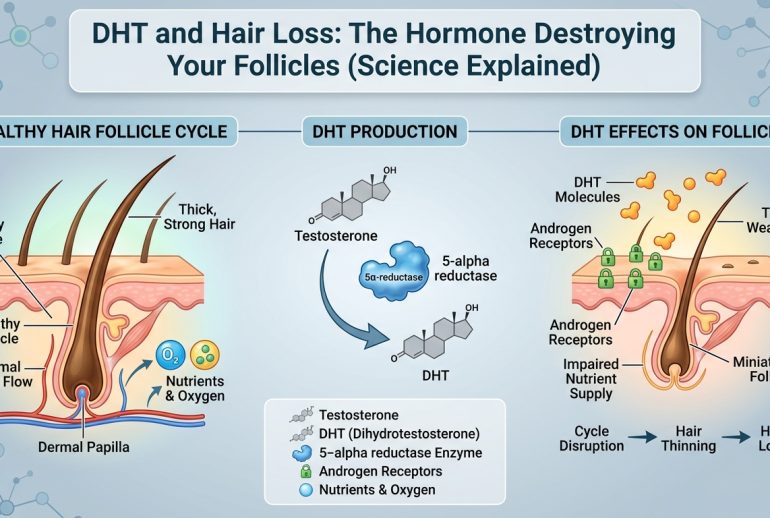
DHT forms when the enzyme 5-alpha reductase converts testosterone in various body tissues, including hair follicles. This process occurs naturally in both men and women, though men typically produce significantly higher levels.
There are two main types of 5-alpha reductase enzyme:
Type 1 is found primarily in the skin and sebaceous glands (oil glands) across the body. Type 2 is found in high concentrations in the scalp’s hair follicles, the prostate, and the epididymis.
This is a crucial distinction, because balding scalp tissue contains significantly higher concentrations of Type 2 5-alpha reductase than non-balding areas. Research published as far back as 1996 confirmed that balding scalp follicles have elevated Type 2 enzyme activity compared to follicles in the occipital region (the back and sides of the scalp), and a double-blind study found that DHT levels were measurably higher in bald scalp tissue than in hair-covered scalp. This is part of why the back and sides of the head — the “safe donor zone” used in hair transplants — are resistant to DHT-induced hair loss.
Here is the key paradox that makes DHT so fascinating from a biology standpoint: it is the same hormone that drives beard growth, chest hair growth, and pubic hair development. Yet on the scalp, in genetically susceptible individuals, it does the opposite — it causes hair to shrink, thin, and eventually disappear. The same signal that says “grow more hair here” says “stop growing hair there.” The difference lies entirely in the androgen receptors within the follicle, and how genetically programmed they are to respond.
The Genetics Behind DHT Sensitivity
Not everyone’s follicles respond to DHT the same way. Whether yours do — and how aggressively — is largely written in your DNA.
The androgen receptor gene (AR gene), located on the X chromosome, is one of the primary genetic determinants of DHT sensitivity. Variants in this gene affect how strongly androgen receptors in the hair follicle bind to DHT. A follicle with highly sensitive receptors will begin miniaturising in response to relatively modest DHT levels; a follicle with low sensitivity may tolerate high DHT levels throughout a lifetime without significant hair loss.
This is why pattern hair loss is strongly hereditary, and why it does not always follow a predictable pattern even within the same family. The genetics are polygenic — meaning dozens of genes contribute to your overall susceptibility, not just one. The old belief that baldness is inherited exclusively from the maternal grandfather is a myth: research confirms the gene variants come from both parents and multiple chromosomal locations.
What this means practically: DHT is not the villain working alone. It is the trigger that activates genetic programming that was already there. Two people can have identical DHT levels; one will have significant hair loss, the other will not. This also explains why DHT-blocking medications work for most people but not all — if androgen receptor sensitivity is the primary driver rather than DHT levels themselves, reducing DHT helps but does not eliminate the underlying programming.
How DHT Actually Destroys Your Follicles
This is the mechanism that matters most, and it is worth understanding in detail. The process has a specific name: follicular miniaturisation. It does not happen overnight. It is a gradual, progressive shrinking that unfolds over years and sometimes decades.
Here is exactly how it happens, step by step:
Step 1: DHT binds to androgen receptors in the dermal papilla. The dermal papilla is the cluster of specialised cells at the base of the hair follicle that controls the growth cycle. When DHT binds to androgen receptors in these cells, it triggers a cascade of molecular changes — including the upregulation of suppressive signalling molecules like TGF-β2, DKK1, and IL-6. These paracrine factors interfere with the growth signals that keep the follicle in its active phase.
Step 2: The anagen (growth) phase is shortened. Instead of lasting the normal two to seven years, the anagen phase shortens progressively with each hair cycle. A follicle that used to keep a hair growing for five years might produce only three years, then eighteen months, then six months of growth in successive cycles. Each time the follicle cycles, the window of active growth shrinks a little more.
Step 3: The follicle physically miniaturises. As anagen shortens, the follicle itself becomes smaller. The hair shaft it produces becomes finer and shorter with each cycle. What was once a thick terminal hair becomes progressively finer — transitioning through intermediate hair to fine vellus hair (the colourless, downy hair covering most of the body). Eventually, the follicle may become so small that it produces no visible hair at all.
Step 4: The Wnt/β-catenin pathway is suppressed. DHT also interferes with the Wnt/β-catenin signalling pathway, which is one of the most critical molecular switches for maintaining the anagen phase and promoting follicle regeneration. When DHT suppresses Wnt activity, it removes one of the key pro-growth signals the follicle depends on to stay in its active state. This is a particularly significant finding because Wnt activation is also being investigated as a potential therapeutic target for reversing — not just stopping — hair loss.
Step 5: Chronic inflammation develops. Emerging research suggests that DHT-mediated hair loss is not purely hormonal — it is also inflammatory. Perifollicular fibrosis (scarring around the follicle) and chronic low-grade inflammation in the dermis appear to compound the damage, making the follicle environment progressively more hostile to regeneration. This chronic inflammatory component is one reason why long-standing pattern hair loss is harder to treat than recently established loss.
The result of all five steps playing out over years is the recognisable pattern: in men, a receding hairline at the temples and thinning at the crown; in women, a widening central parting and diffuse thinning across the top of the scalp.
DHT and Hair Loss in Women: A Different Picture
Pattern hair loss in women is frequently misunderstood — both by the people experiencing it and sometimes by the clinicians treating them. The assumption that it is simply a “female version” of male pattern baldness is inaccurate.
Female pattern hair loss (FPHL) is characterised by diffuse hair thinning over the crown and parietal scalp with retention of the frontal hairline. This is markedly different from the receding hairline and crown baldness seen in men.
The relationship between DHT and FPHL is also more complicated than in men. The pathogenesis of FPHL remains unclear — evidence suggests normal hormone levels in most balding females, and there is uncertainty regarding its hereditary nature. In other words: many women with significant pattern hair loss have normal DHT levels on blood tests. This suggests that in many women, local androgen receptor hypersensitivity within the follicle — rather than elevated circulating DHT — is the primary driver.
This distinction has treatment implications. Anti-androgen medications work in women by reducing the effect of androgens at the follicle level, even when circulating DHT levels are not elevated.
Women who do have elevated androgen levels — particularly those with PCOS, adrenal disorders, or hormonal shifts around menopause — often see more aggressive FPHL, and in these cases, addressing the underlying hormonal imbalance is a central part of treatment.
DHT vs Hair Growth: The Paradox Visualised
Here is something worth pausing on before we get to treatments. DHT does not affect all hair equally. The same hormone that miniaturises scalp hair actually promotes growth in other areas.
Beard hair, body hair, and pubic hair follicles respond to androgens by growing. Scalp follicles — in genetically susceptible individuals — respond by shrinking. The difference is entirely in the androgen receptor programming encoded in the follicle’s dermal papilla cells.
This means that a man with high DHT may have a full beard and thick body hair while simultaneously experiencing progressive scalp hair loss. His DHT is doing exactly what it is programmed to do in every follicle — the follicles themselves are simply programmed differently depending on their location.
It also means that reducing DHT systemically — as finasteride does — will reduce DHT everywhere in the body, including in beard follicles and body hair. In practice, this rarely produces a noticeable effect on beard or body hair density at therapeutic doses, but it is the biological reason why it happens at all.
Every Treatment Option — Ranked by Clinical Evidence
There are more DHT-related treatment options available today than at any previous point in history. Here is an honest, evidence-based breakdown of all of them, from the strongest clinical evidence down to emerging options.
Tier 1: Prescription Medications — Strongest Evidence
Finasteride (1mg daily, oral)
Finasteride is a Type 2 5-alpha reductase inhibitor. It works by blocking the enzyme that converts testosterone to DHT in the scalp, reducing scalp DHT levels by approximately 60–70%. It is the only 5-alpha reductase inhibitor with FDA approval for the treatment of male androgenetic alopecia.
The clinical evidence is robust: multiple large, randomised controlled trials show that finasteride significantly slows hair loss and promotes visible regrowth in the majority of men who use it. Both finasteride and dutasteride are effective at treating hair loss in male AGA, with studies finding dutasteride was more efficacious than finasteride. Many studies reported sexual adverse effects of 5-ARIs that are uncommon and resolve spontaneously, although there remains no consensus with respect to the presence, severity, and duration of sexual adverse effects.
For women: finasteride is used off-label for FPHL at higher doses (2.5mg to 5mg daily). The dosage of finasteride for FPHL ranges from 1 to 5 mg daily. It is not prescribed to women who may become pregnant due to the risk of affecting development in a male foetus. A 2025 retrospective study from Imperial College London found that 92.4% of men using combined oral minoxidil and finasteride achieved stable or improved outcomes over 12 months, with 57.4% showing marked improvements.
Dutasteride (0.5mg, oral — off-label for hair loss in most countries)
Dutasteride is a more potent option that inhibits both Type 1 and Type 2 5-alpha reductase, reducing DHT more comprehensively than finasteride. It reduces circulating DHT by approximately 90% compared to finasteride’s 60–70%.
A 2025 randomised trial published in JAAD International compared intermittent dutasteride dosing to daily finasteride in 60 men with AGA. Thrice-weekly dutasteride showed a greater moderate-to-marked improvement than once-daily finasteride (35% vs 21%), with similar sexual adverse events across groups.
Dutasteride is approved for hair loss in South Korea, Japan, and Taiwan, and is used off-label in the US, UK, Canada, and Australia. It is generally not prescribed to women of childbearing age due to teratogenicity concerns.
Spironolactone (for women)
Spironolactone is an aldosterone antagonist with anti-androgen properties. It works by blocking androgen receptors throughout the body and inhibiting androgen production in the adrenal glands — reducing the effect of DHT and other androgens at the follicle level. It is the most commonly prescribed anti-androgen for women with FPHL in the US and UK.
Four studies of 192 patients assessed changes in hair loss following oral spironolactone treatment. The overall rate of improved hair loss was 56.60%, with combined therapy (spironolactone + minoxidil) showing 65.80% improvement.
A 2025 updated review confirmed that minoxidil combined with spironolactone was better than minoxidil combined with finasteride in terms of hair density and hair loss improvement, suggesting that spironolactone may be more suitable for female patients.
Tier 2: Over-the-Counter — Strong Supporting Evidence
Minoxidil (topical 2%/5% or oral)
Minoxidil is not a DHT blocker — it works through a separate mechanism (vasodilation and direct effects on follicle stem cells) — but it is the most widely used hair loss treatment globally and produces its best results when combined with DHT-blocking approaches. In a UK-based service evaluation of 502 men, 92.4% of those on combined oral minoxidil and finasteride achieved stable or improved outcomes.
Ketoconazole shampoo (2%)
Originally an antifungal medication, ketoconazole has demonstrated mild DHT-blocking activity in clinical studies. It inhibits certain steps in androgen synthesis and reduces scalp inflammation. Some research suggests 2% ketoconazole shampoo used regularly may modestly reduce scalp DHT activity. It is best viewed as a supportive measure alongside primary treatments, not a standalone solution.
Tier 3: Natural and Supplementary Options — Modest Evidence
Saw palmetto (Serenoa repens, 320mg standardised extract)
Saw palmetto works by partially inhibiting 5-alpha reductase, in the same direction as finasteride but with a lower ceiling effect. Small clinical trials show that 320mg of standardised saw palmetto extract can reduce serum DHT by about 30% within six months, while clinical reviews report improved hair quality in 60% of participants and a 27% rise in total hair count.
A 2023 randomised placebo-controlled trial found that standardised oral saw palmetto extract produced a marked reduction in serum DHT levels compared to placebo, with a significant reduction in hair fall and increased hair density over 16 weeks.
Saw palmetto is not a replacement for prescription options in cases of moderate to severe hair loss, but the evidence supports its use as a gentle supplementary approach — particularly for those in early stages or who are not candidates for prescription medication.
Pumpkin seed oil (400mg daily)
A 2014 randomised, double-blind, placebo-controlled trial from Pusan National University followed 76 men with mild to moderate AGA taking 400mg pumpkin seed oil daily for 24 weeks. The pumpkin seed oil group showed a 40% improvement in hair count — significantly more than placebo. The mechanism is thought to involve phytosterols that inhibit 5-alpha reductase activity at the scalp.
Pumpkin seed oil has reduced scalp DHT by 40% in limited studies, with results that are milder and slower than prescription finasteride, but side-effects are also fewer.
As with saw palmetto, pumpkin seed oil shows genuine promise but limited study scale. Quality of evidence is lower than for prescription options.
Rosemary oil (topical)
Rosemary oil has attracted significant scientific attention following a 2023 trial that found it comparable to 2% minoxidil for androgenetic alopecia over six months, with fewer scalp side effects. While its mechanism is not fully through DHT blockade (it appears to primarily work through improved scalp circulation and anti-inflammatory effects), it has a meaningful supporting role in comprehensive DHT management protocols.
Tier 4: Emerging Treatments — Promising but Early
Topical finasteride
Topical finasteride — applied directly to the scalp rather than taken orally — is gaining traction as an alternative that may reduce systemic DHT suppression while maintaining local scalp efficacy. Early real-world data from a 2026 study in the International Journal of Dermatology shows meaningful improvement in hair density with good tolerability. It is not yet approved in most countries but is increasingly available through specialist prescribers.
Stem cell and secretome therapies
Regenerative approaches using exosomes, growth factors, and stem cell-derived secretomes are the frontier of hair loss science in 2025. These target the damage DHT causes at the cellular level — attempting to reactivate miniaturised follicles rather than simply slowing the process. Results from early clinical studies are encouraging, but these therapies remain experimental and largely unavailable outside specialist centres.
DHT Myths — Set the Record Straight
“High testosterone means more hair loss.” Not directly. What matters is how much of your testosterone is converted to DHT (determined by your 5-alpha reductase enzyme activity and density) and how sensitive your follicles are to DHT. Plenty of men with high testosterone maintain a full head of hair; some men with lower testosterone still experience significant hair loss because of follicle sensitivity.
“Only men are affected by DHT hair loss.” False. Women produce DHT too, albeit in smaller quantities. Female pattern hair loss shares the same androgen-mediated mechanism in many cases, and anti-androgen treatments work in women for exactly this reason.
“If you’re going bald, your DHT must be high.” Not necessarily. As noted above, many women — and some men — with pattern hair loss have normal DHT blood levels. Local androgen receptor hypersensitivity within genetically susceptible follicles can drive miniaturisation even without elevated systemic DHT.
“DHT blockers will kill your libido.” This is the concern most men have about finasteride. The data shows sexual side effects occur in a minority of users — approximately 1.4–3.8% in controlled trials — and typically resolve after discontinuing the medication. Many studies reported sexual adverse effects of 5-ARIs that are uncommon and resolve spontaneously. The decision to use finasteride should be made in conversation with a doctor, with a clear understanding of both benefits and risks.
“Natural DHT blockers work just as well as medication.” They do not — not at the same speed or magnitude. Saw palmetto and pumpkin seed oil have genuine evidence behind them, but their effect is partial and slower than prescription finasteride. For mild or early-stage loss, they may be sufficient. For progressive or moderate-to-advanced loss, they are unlikely to be enough on their own.
“Once you start DHT blockers you have to take them forever.” For prescription medications like finasteride, yes — stopping treatment typically leads to resumption of hair loss within six to twelve months. This is not a flaw; it reflects the fact that DHT continues to be produced throughout life. The treatment manages the condition rather than curing the underlying genetic predisposition.
What to Do: A Practical Framework
If you have early-stage hair loss (thinning noticeable but limited): Consider starting with saw palmetto, rosemary oil, and scalp massage as a conservative, low-risk initial protocol while you evaluate your options. Get a blood panel to rule out other contributing causes (iron, vitamin D, thyroid). Consult a dermatologist early — the earlier treatment starts, the better the results.
If you have moderate hair loss: Prescription treatment becomes increasingly justified. Minoxidil + finasteride (for men) or minoxidil + spironolactone (for women) represents the most evidence-backed combination available without surgery. Low-level laser therapy can be added as a supportive measure.
If you have advanced hair loss: The follicles that are already completely miniaturised cannot be reactivated by current mainstream treatments. Medical management can protect remaining follicles and may improve areas of miniaturised hair, but hair transplantation may be the most appropriate option for restoring density in areas of established baldness. Consult a board-certified dermatologist or hair restoration specialist for a personalised assessment.
Regardless of stage: Be patient. DHT-related treatments show results over months, not weeks. Finasteride typically shows its full effect at twelve months; minoxidil at six to twelve months. Stopping early because you do not see immediate results is one of the most common reasons treatment fails.
FAQ
Q: Can I test my DHT levels at home or through a GP? A: Yes — DHT can be measured through a standard blood test. However, as noted above, a normal DHT level does not rule out pattern hair loss, because follicle sensitivity rather than circulating DHT is often the key variable. DHT testing is most useful when ruling out hormonal disorders or evaluating treatment response.
Q: Does diet affect DHT levels? A: Modestly. Foods high in zinc and saw palmetto phytosterols may have mild 5-alpha reductase inhibitory effects. Very high saturated fat intake has been associated in some research with increased DHT production. However, the effect of diet on DHT is small compared to genetics and medication. You cannot eat your way out of androgenetic alopecia.
Q: Can women use finasteride for hair loss? A: Yes, off-label and at higher doses than those used in men. The dosage of finasteride for FPHL ranges from 1 to 5 mg daily. It is not prescribed to women who may become pregnant due to teratogenicity risk. Spironolactone is generally preferred as the first-line anti-androgen for women in most countries.
Q: Do DHT-blocking shampoos work? A: Shampoos labelled as “DHT blockers” — often containing saw palmetto, caffeine, or ketoconazole — may have a modest supportive effect on the scalp environment. Ketoconazole at 2% concentration has the strongest evidence among shampoo ingredients. However, a shampoo alone cannot stop or reverse established pattern hair loss — it is at best a supporting measure alongside more direct treatments.
Q: Is DHT hair loss permanent? A: In most cases, the loss of visible hair from miniaturised follicles can be partially recovered if treatment is started before the follicle is completely scarred and inactive. The longer the follicle has been miniaturised, the harder it is to reverse. This is why early intervention consistently produces better outcomes than delayed treatment.
Q: Can stress raise DHT levels? A: Not directly. Chronic stress elevates cortisol, which can disrupt the hair growth cycle through a separate mechanism (telogen effluvium). However, stress does not significantly elevate DHT production. The two mechanisms — DHT-driven miniaturisation and stress-driven shedding — can occur simultaneously, and their combined effect can accelerate the appearance of hair loss.
Conclusion: Key Takeaways
DHT is not a villain to be feared — it is a hormone doing exactly what it is genetically programmed to do. The challenge is that in susceptible follicles, that programming leads progressively toward hair loss. Understanding this mechanism gives you the clearest possible picture of why certain treatments work and others do not.
Here is what to carry forward:
- DHT is made from testosterone by the enzyme 5-alpha reductase, with Type 2 being most active in scalp hair follicles.
- The mechanism is follicular miniaturisation — a progressive shortening of the growth phase and shrinking of the follicle across repeated hair cycles. It is slow, cumulative, and accelerating once it starts.
- DHT sensitivity is genetic — your follicles’ response to DHT is largely predetermined. Blood DHT levels and hair loss severity do not always correlate.
- In women, FPHL often occurs with normal DHT levels — local androgen receptor sensitivity within genetically susceptible follicles, not elevated systemic DHT, is the primary driver in many cases.
- Prescription medications (finasteride, dutasteride, spironolactone) have the strongest evidence and are the most direct tools for interrupting the DHT pathway.
- Natural options (saw palmetto, pumpkin seed oil) have genuine but modest evidence — appropriate for early-stage loss or as adjuncts, not as substitutes for prescription treatment in progressive cases.
- Treatment works best when started early, before follicles are fully miniaturised and before chronic inflammation has set in around them.
- Patience is essential — meaningful results from DHT management take six to twelve months. Abandoning treatment prematurely is the most common cause of apparent failure.
If you are concerned about pattern hair loss, the most useful first step is a consultation with a dermatologist who specialises in trichology. A proper scalp assessment combined with targeted blood work gives you the clearest picture of what is driving your hair loss — and what treatments are most likely to work for you specifically.
Research sources: ScienceDirect / PMC / PubMed (multiple studies), Georgetown Medical Review (2024), JAAD International (2025), Tandfonline AGA Update (2025), Harvard Stem Cell Institute, International Journal of Dermatology (2026), Cureus / Imperial College London (2025), GoodRx, ISHRS