
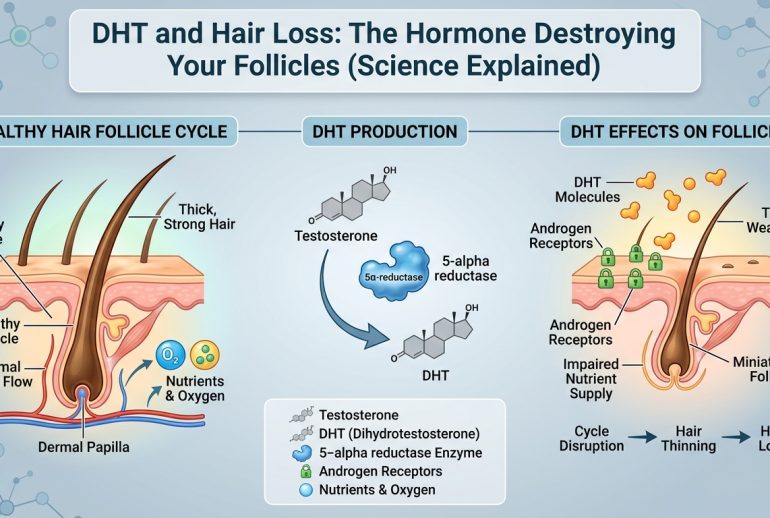
DHT and Hair Loss: Causes, Treatments and What the Evidence Says
DHT contributes to inherited pattern hair loss by changing how susceptible follicles grow. Over time, those follicles can produce shorter, finer hairs. But DHT does not explain every type of shedding, and a thinning scalp does not automatically mean your hormone levels are abnormal.
This guide explains the connection, the treatments with established evidence, and the limits of popular “natural DHT blocker” claims. If your main concern is sudden shedding rather than gradual thinning, start with our guide to why your hair may be falling out.
What is DHT?
Dihydrotestosterone, usually shortened to DHT, is an androgen: a hormone involved in sexual development and the growth of hair in some body regions. An enzyme called 5-alpha reductase converts testosterone into DHT. This is a normal process; DHT is not a toxin that needs to be “detoxed” from your body.
The important issue for scalp hair is how genetically susceptible follicles respond to the hormone. DermNet explains that male pattern hair loss involves both inherited susceptibility and androgen activity. Genes from either side of the family can contribute.
How does DHT affect hair follicles?
A follicle cycles between growing, transitioning and resting. In pattern hair loss, the growth phase becomes shorter and affected follicles gradually become smaller. This process is called miniaturisation. The resulting hairs are finer and shorter, making the scalp more visible even before an area appears bald.
In men, the usual pattern involves the temples, hairline and crown. This gradual change is different from a sudden increase in hairs in the shower after an illness or a stressful period. Those symptoms may have another cause, and more than one condition can occur together.
Does normal DHT rule out pattern hair loss?
No. A blood hormone result is not a measurement of how each scalp follicle responds to hormones. Assessment usually starts with the pattern of thinning, your history and a scalp examination. A clinician may order tests when your symptoms suggest a deficiency, hormonal problem or another condition. Buying a DHT test does not replace that assessment.
DHT and hair loss in women
Female pattern hair loss often appears as a widening part or thinning over the top of the scalp. It is hereditary, but its biology is more complex than simply having “too much DHT.” Many affected women have normal hormone tests. A clinician should assess accompanying symptoms, such as irregular periods or new excess facial hair, rather than assuming every case is caused by high androgens.
The American Academy of Dermatology recommends confirming the cause before treating apparent female pattern hair loss. Its advice identifies topical minoxidil as the most recommended treatment and explains that prescription options require an individual assessment.
Which treatments have the strongest evidence?
A 2024 systematic review covering 141 studies examined medicines, topical products and procedures for androgenetic alopecia. Treatment selection depends on diagnosis, suitability, side effects and preferences. These options are not interchangeable, and none guarantees regrowth.
Finasteride: a prescription DHT-reducing medicine
Oral finasteride inhibits 5-alpha reductase and is an established treatment for male pattern hair loss. It can help slow progression and improve growth in suitable patients. Benefits generally require continued treatment. It should be discussed with a prescriber, including your medical history and the potential adverse effects.
Safety matters: the UK Medicines and Healthcare products Regulatory Agency warns about depression, suicidal thoughts and sexual dysfunction. Sexual problems have sometimes persisted after treatment stopped. For people taking finasteride 1 mg for hair loss, its advice is to stop the medicine and contact a doctor promptly if depression or suicidal thoughts develop. Discuss sexual side effects with your prescriber.
Topical minoxidil: established treatment, different mechanism
Minoxidil is not a DHT blocker. Topical formulations can help treat pattern hair loss and are available without a prescription in many countries. Follow the instructions for the specific product. Possible problems include scalp irritation and unwanted hair growth outside the treated area. Results need months of consistent use, and benefits are lost after stopping.
Oral minoxidil is different: it is a prescription medicine used off-label for hair loss, not an over-the-counter alternative to the topical product. It requires a clinician’s assessment and monitoring. The AAD advises avoiding minoxidil during pregnancy, when planning pregnancy and while breastfeeding.
Other prescription options
A specialist may consider dutasteride or, for some women, spironolactone. Approval and off-label use vary by country. These medicines have their own risks and contraindications; they should not be started using an online treatment “stack.” Prescription hair-loss medicines can be unsuitable during pregnancy or when pregnancy is possible.
Topical finasteride is not automatically risk-free
Applying finasteride to the scalp does not mean that only the scalp is exposed. The FDA has warned about compounded topical finasteride products, including systemic adverse effects and unintended exposure to others. Compounded topical products are not FDA-approved. Ask a prescriber about the particular formulation and precautions.
Do rosemary oil and natural DHT blockers work?
“Natural DHT blocker” is a marketing description, not proof that a product treats pattern hair loss. Laboratory effects, changes in hormone measurements and visible hair regrowth are different outcomes. Evidence from one preparation also cannot automatically be applied to every shampoo, supplement or homemade mixture.
Rosemary oil
The often-cited rosemary oil comparison trial was published in 2015. It allocated 100 people to rosemary oil or 2% minoxidil for six months. Both groups had higher hair counts at six months, without a statistically significant difference between groups.
That finding does not establish that rosemary oil is equivalent to every minoxidil product or that it blocks scalp DHT in people. The study did not compare it with 5% minoxidil, and absence of a statistically significant difference is not proof of equivalence. Itching increased in both groups. Avoid treating essential oils as harmless substitutes for a diagnosis.
Pumpkin seed oil and supplements
A small 2014 placebo-controlled trial examined an oral pumpkin seed oil preparation in 76 men. It provides a reason for further research, but does not establish that ordinary topical pumpkin oil lowers scalp DHT by a fixed percentage. Supplements should not be presented as reliable substitutes for established treatment.
What should you do if you notice thinning?
Arrange an assessment if thinning is new, progressing or worrying you. Record when it began, any illness or medication changes, and whether you have scalp pain, scaling or patches. Consistent photographs of your part and hairline can help you describe the change.
Discuss the benefits and risks of treatments that fit your diagnosis. If your clinician recommends one, agree on how long to try it and how to assess progress. Do not keep adding products every few weeks: it makes irritation and results harder to interpret.
Frequently asked questions
Can DHT-related hair loss improve?
Treatment can slow progression and improve density in some people. Response varies, and long-standing areas of loss may be harder to improve. Full restoration is not guaranteed.
Can shampoo wash DHT away?
No. Shampoo cleans the scalp; it does not simply wash a hormone out of follicles. Evidence for a medicine cannot be transferred to a shampoo because both are described as “DHT blocking.”
Does a full beard mean I have too much DHT?
No. Body hair and scalp hair respond differently to androgens. Appearance alone cannot diagnose an abnormal hormone level.
Should I start with an oil before seeing a doctor?
You do not need to wait for an oil to fail before seeking advice. Identifying the cause early gives you a better basis for choosing treatment. For a broader overview, read our guide to hair shedding and thinning.
Sources and editorial note
Sources are linked beside the claims they support. This article was editorially updated by Care The Hair on 6 October 2026. It provides general education and does not diagnose hair loss or prescribe treatment.

One Response