
Hair Loss & Thinning · Guide 5
Female Pattern Hair Loss: Why Your Part Is Widening and What Helps
In this guide
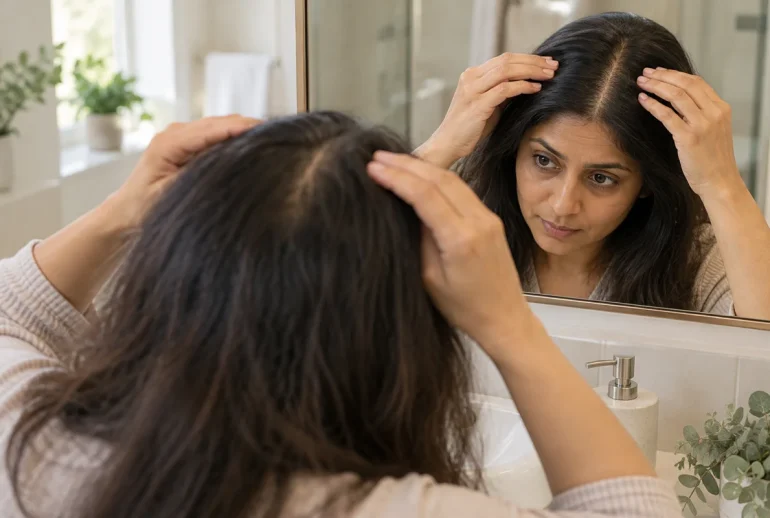
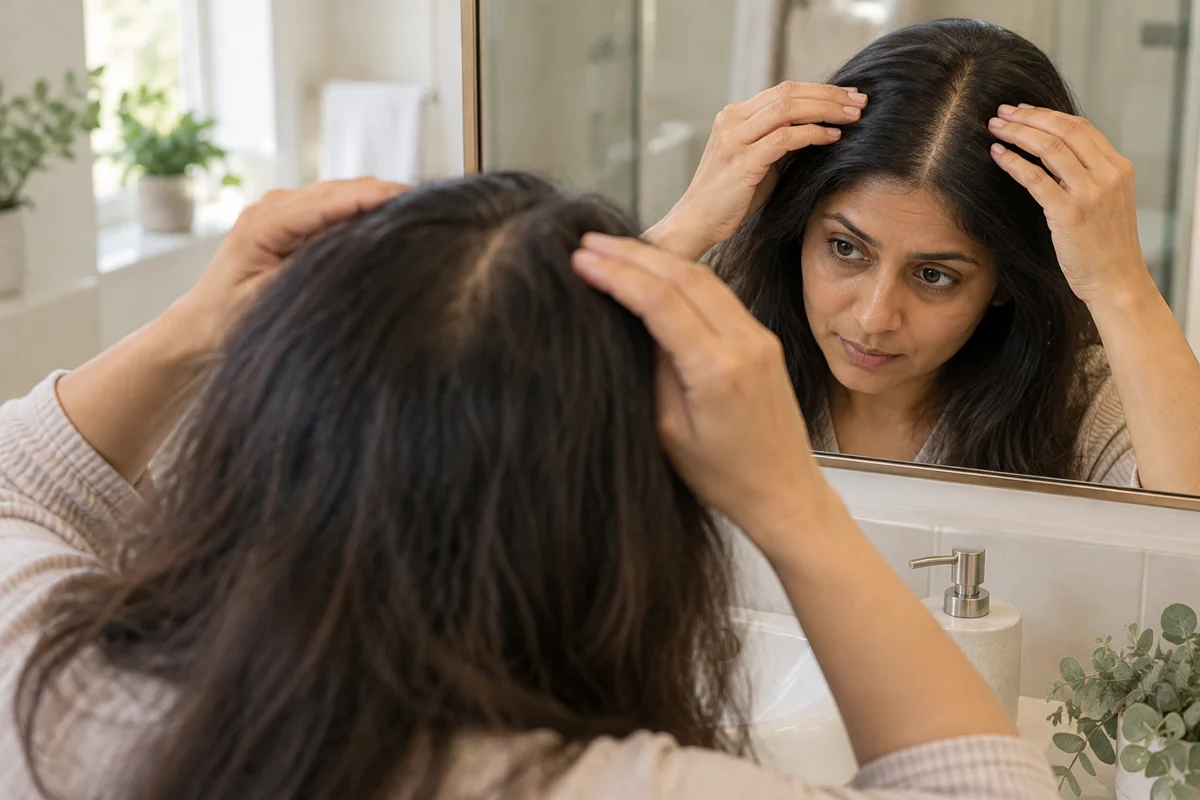
You might notice it in a photograph first. Your part looks wider than it used to. Your ponytail feels smaller, even though you have not changed how you tie it. Under bright bathroom lights, more scalp shows through at the top of your head.
These changes can happen with female pattern hair loss, but they do not prove that you have it. Temporary shedding, breakage and other scalp conditions can look similar. Getting the cause right matters because the treatment that helps one problem may do very little for another.
This guide explains what to look for, what a medical assessment involves, and what the research actually says about treatment. If you are still trying to work out whether you are shedding or thinning, start with our guide to 12 possible causes of hair loss.
What is female pattern hair loss?
Female pattern hair loss, often shortened to FPHL, is a common form of gradual thinning. You may also see it called androgenetic alopecia in women.
Affected follicles begin producing finer, shorter hairs. Doctors call this miniaturisation. Over time, those smaller hairs provide less coverage, even when there is still hair growing in the area. Understanding the hair growth cycle makes this easier to picture: changes in successive cycles can affect the thickness and length of the hair produced.
The condition is usually nonscarring, meaning it does not typically destroy follicles through scar formation. However, other conditions can resemble it. A widening part should not automatically be labelled FPHL without an assessment.
What does it look like?
Common clues include a slowly widening central part, reduced coverage over the crown, and hair that seems finer on top. The front hairline often remains fairly similar, although this is not an absolute rule. The British Association of Dermatologists’ patient information describes this pattern of thinning and the importance of examining the scalp.
It can develop earlier in adulthood as well as around or after menopause. Having no obvious family history does not rule it out. Complete baldness is not the usual pattern in women, but thinning can still affect confidence and daily life.
One photograph is a poor way to judge progression. Wet hair, oily roots, a different part or stronger lighting can make the same scalp look very different. If you track changes, use dry hair, the same part, similar lighting and the same camera angle. Monthly photographs are usually more useful than daily checking.
Is it pattern hair loss or temporary shedding?
The timing offers clues, but it cannot make the diagnosis by itself.
| What you notice | What it may suggest |
|---|---|
| A part that gradually widens over months or years | Female pattern hair loss is one possibility |
| Increased shedding beginning a few months after illness, childbirth, major stress or rapid weight loss | Telogen effluvium is one possibility |
| Short, snapped strands after repeated heat, bleaching or friction | Hair-shaft breakage may be contributing |
| Smooth patches, a painful scalp, pronounced scaling or loss of eyebrows | A different condition needs assessment |
FPHL and telogen effluvium can occur together. A sudden shedding episode may make previously subtle thinning easier to see. DermNet’s explanation of female pattern hair loss discusses why distinguishing it from chronic telogen effluvium matters. Our telogen effluvium guide explains the delayed shedding that can follow a trigger.
That is why “it must be stress” is not always a useful answer. Stress may be part of the history, but the distribution of thinning and the scalp examination still matter.
Does it mean your hormones are abnormal?
Not necessarily. Genetics and hormonal influences are involved, but many women with FPHL have normal androgen levels in their blood. Its biology is less straightforward than simply having too much DHT. DermNet also notes uncertainty about the precise role of androgens and oestrogen in women.
Our DHT and hair loss article explains follicle susceptibility, but a normal hormone result does not exclude FPHL. Equally, thinning alone does not diagnose PCOS. Tell your doctor if you also have irregular periods, new facial hair or troublesome acne, because those symptoms can change the assessment.
Do not start a “hormone-balancing” supplement or change contraception based on a hair-loss article. Bring the names of your medicines and supplements to the appointment instead.
What will a doctor check?
A useful assessment starts with your timeline: when you first noticed changes, whether shedding was sudden, recent illnesses, weight changes, pregnancy history, medicines and family history. The clinician examines both the distribution of thinning and the skin underneath it.
A dermatologist may use a dermatoscope to look at hair thickness and follicular openings. A biopsy is sometimes needed when the diagnosis is uncertain, especially if scarring hair loss is a concern.
Blood tests are selected according to the findings. Iron studies, including ferritin, and thyroid tests can help when another cause of shedding is suspected. You do not automatically need an expensive panel of every vitamin and hormone. A 2026 clinical summary in CMAJ supports reserving additional investigations for suspected alternative diagnoses; the AAD’s diagnosis guidance likewise describes testing when the history or examination suggests another underlying problem.
Useful questions to take with you are:
- Does my pattern suggest FPHL, telogen effluvium, or both?
- Are there signs of inflammation or scarring?
- Which tests would change my treatment, and why?
- What would count as a good response, and when should we review it?
Which treatments have evidence?
Topical minoxidil: the usual starting point
Topical minoxidil has the most established evidence for FPHL. It can help preserve coverage and support some regrowth, although results vary. It does not remove the underlying tendency to thin.
A Cochrane review published in 2016 assessed 47 trials involving 5,290 women. In six pooled studies, about 27% of women using minoxidil reported moderate to marked regrowth, compared with about 14% using placebo. This is a meaningful difference, but it is not a guarantee of dramatic regrowth. The review judged much of the evidence moderate or low quality and searched studies only through July 2015; it should not be presented as a review of every treatment available today.
Products differ in strength, formulation and approved instructions. Follow the relevant product label and your clinician’s advice rather than copying someone else’s routine.
The AAD’s patient guide advises allowing roughly six to twelve months to judge how well minoxidil works. Some people notice temporary extra shedding early on. Irritation and unwanted hair growth outside the scalp can occur. Continuing treatment is generally needed to maintain its benefit. Avoid minoxidil during pregnancy, while trying to conceive and during breastfeeding, and discuss suitable alternatives with your clinician.
Prescription treatments: an individual decision
Doctors sometimes consider low-dose oral minoxidil or an antiandrogen such as spironolactone when topical treatment is unsuitable or insufficient. These are off-label for hair loss in many settings, so the benefits, risks and monitoring need a personal discussion.
Oral minoxidil can cause unwanted body hair, swelling, dizziness or cardiovascular effects. It is not simply a more convenient version of the topical product that everyone can safely take. A clinical review of low-dose oral minoxidil discusses these risks and the limits of the available studies.
Spironolactone also requires a review of other medicines, kidney health, blood pressure and whether potassium monitoring is needed. It is unsuitable during pregnancy. Finasteride is not a routine self-treatment for women and has important pregnancy risks. The BAD patient leaflet explains why prescription options require medical supervision.
PRP, laser devices and supplements
Some studies suggest benefit from platelet-rich plasma injections and low-level light devices, but protocols, costs and evidence quality vary. They should not be sold as certain replacements for established treatment. Ask what evidence supports the specific device or procedure being offered, how many sessions are needed, and what ongoing costs look like.
Supplements make more sense when there is a confirmed deficiency than as a blanket response to thinning. In AAD guidance featuring dermatologist Dr Paradi Mirmirani, the emphasis is on early, individual assessment and using supplemental vitamins when a deficiency exists. A shampoo that makes strands feel thicker may improve appearance without treating follicle miniaturisation.

What can you do while waiting for an appointment?
Write a short timeline and gather older photographs that show your usual part. List medicines and supplements, including anything started or stopped before the shedding began. Mention changes in periods or diet rather than assuming they are unrelated.
Keep styling comfortable and avoid repeatedly pulling on thinning areas. Cosmetic hair fibres, a different part or a suitable hairpiece can help with appearance if you want them. They do not need to be treated as evidence that you have “given up” on treatment.
Book a medical assessment sooner if loss is patchy or rapid, or if you have scalp pain, burning, marked redness, crusting or eyebrow loss. Those changes deserve a diagnosis rather than months of product experiments. The Cleveland Clinic Journal of Medicine review explains the examination findings that help distinguish pattern hair loss from other conditions.
Common questions
Can it grow back? Treatment may improve density and can help slow further thinning. Returning completely to your previous density is not assured. Keeping your existing coverage can be a worthwhile response even without obvious new growth.
Can normal blood tests mean nothing is wrong? No. Blood tests do not measure every change inside a follicle. A scalp assessment can still identify pattern thinning when routine results are normal.
Should I wait until it becomes obvious? You do not need to wait for severe thinning to ask for help. An earlier assessment gives you more time to identify the cause and discuss options.
How will I know whether treatment is helping? Agree on a review date and compare consistent photographs, your examination findings and any change in shedding. Avoid judging the whole treatment by one wash day.
If your part is widening, you do not need to buy several treatments at once. Start with a diagnosis, ask what each option can realistically achieve, and choose a plan you can sustain.