
Hair Loss & Thinning · Guide 6
Postpartum Hair Loss: When It Starts, What Helps and When to Get Checked
In this guide
- What causes postpartum hair loss?
- When does postpartum hair loss start and stop?
- Is this ordinary shedding or something else?
- Does breastfeeding cause postpartum hair loss?
- What actually helps with postpartum hair loss?
- Can oils, scalp massage or special shampoos stop the shedding?
- When should you see a doctor?
- Common myths about hair loss after pregnancy
- A simple plan for the next month
- Frequently asked questions
- Conclusion: the key takeaways
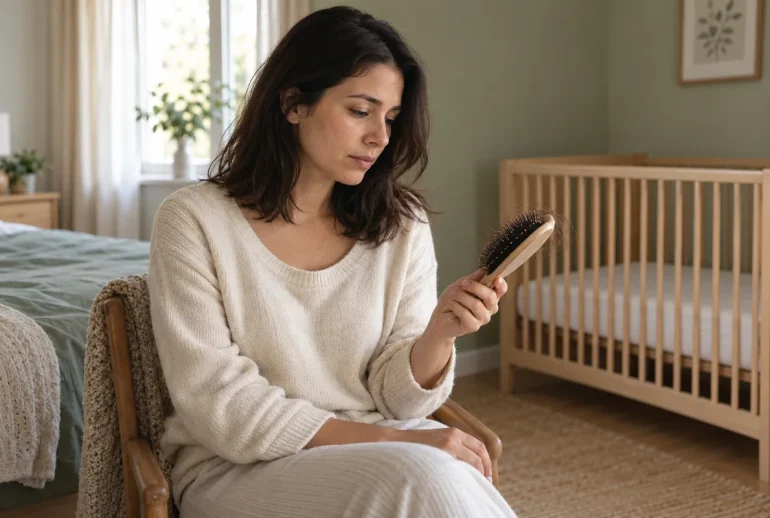
You run your fingers through your hair and find more strands than usual. There is hair on your clothes, in the shower and around the brush. Your baby is a few months old, and your ponytail suddenly feels smaller.
Being told “it’s normal” does not answer everything. How long will this last? Is breastfeeding involved? And when should you ask a doctor?
Postpartum hair loss usually means temporary extra shedding after pregnancy. It often starts around three months after birth, becomes most noticeable over the following months, and improves as the hair cycle settles. However, childbirth does not explain every case of thinning. Patchy loss, scalp symptoms or persistent shedding deserve an assessment.
What causes postpartum hair loss?
Hair grows in cycles. Each follicle moves through growth, transition and rest before releasing a hair and beginning another cycle. The follicles do not normally all follow the same schedule.
During pregnancy, hormonal changes can keep more hairs growing for longer, making hair feel fuller. After birth, falling estrogen levels allow more hairs to move into rest together. They shed later, which explains the delay between delivery and the hair you notice in the shower. Johns Hopkins Medicine explains this connection between pregnancy hormones and the hair cycle.
This form of shedding is called telogen effluvium. In a typical episode, the follicle is not being destroyed: it releases a resting hair while growth continues. DermNet’s explanation of telogen effluvium distinguishes temporary shedding from other causes of hair loss.
Our hair growth cycle guide explains the stages. If your symptoms do not fit, explore our 12 possible causes of hair loss.
When does postpartum hair loss start and stop?
The timing varies. A recovery timeline is a guide, not a deadline your body must meet.
| Time after birth | What you may notice | How to interpret it |
|---|---|---|
| First few weeks | Hair may still feel relatively full | Shedding often starts later; immediate loss should not automatically be labelled postpartum shedding |
| Around 2–4 months | More loose hairs during washing or brushing | This fits the common timing of postpartum telogen effluvium |
| Around 4 months and the months nearby | The shedding may be particularly noticeable | The American Academy of Dermatology places the usual peak around four months |
| Over the following months | Less shedding; short new hairs may become visible | Slower shedding and restoration of fullness are different stages of recovery |
| By about 12 months | Many women have regained normal hair growth and fullness | If fullness has not returned, arrange an assessment rather than assuming more waiting will solve it |
The American Academy of Dermatology’s guidance for new mothers supports the four-month peak and recommends a dermatologist’s assessment if normal fullness has not returned by the child’s first birthday.
That does not mean you need to wait a year to ask for help. Cleveland Clinic advises contacting a clinician if hair loss continues for more than six months. Here, distinguish six months of ongoing shedding from simply being six months postpartum.
What does the research say about the timeline?
A 2023 questionnaire study by Hirose and colleagues analysed 331 responses. The average reported start, peak and end of shedding were 2.9, 5.1 and 8.1 months after delivery.
These averages are not personal recovery deadlines. Women answered retrospectively, only about 21% responded, and the authors acknowledged possible selection and recall bias. The study cannot tell us exactly how common shedding is in every population.
Is this ordinary shedding or something else?
Typical postpartum shedding is spread across the scalp. You may see more scalp or a smaller ponytail without having a sharply defined bald patch.
The following clues help you explain the problem at an appointment. They cannot diagnose it at home.
| What you notice | Why it matters |
|---|---|
| Increased shedding across the scalp a few months after delivery | Can fit postpartum telogen effluvium |
| A progressively widening central part, especially if it began before pregnancy | Female pattern hair loss may need consideration |
| A clearly defined bald patch | Another cause, such as alopecia areata, needs assessment |
| Tenderness, redness, persistent scale or burning | A scalp condition may be contributing |
| Short broken pieces, particularly where a style pulls | Breakage or traction may be part of the problem |
DermNet’s guide to diffuse hair loss explains why clinicians distinguish shedding, pattern thinning and other conditions. Our female pattern hair loss guide explains what a widening part can mean.
You can also have more than one problem. A postpartum episode does not rule out an iron deficiency, thyroid problem or existing pattern thinning.
Does breastfeeding cause postpartum hair loss?
Postpartum shedding can happen whether or not you breastfeed. The hormonal change after pregnancy is the usual explanation, so changing feeding method is not a standard hair-loss treatment.
The Hirose study found an association between longer breastfeeding and reported postpartum hair loss. An observational association cannot establish that breastfeeding caused the loss. Nor did the study test whether stopping breastfeeding prevents shedding or restores hair.
Do not stop breastfeeding solely because of this hair-loss claim. Discuss concerns about nutrition, symptoms or treatment with your clinician.

What actually helps with postpartum hair loss?
Supporting recovery, preventing damage and treating another diagnosis are different goals. None instantly switches off postpartum shedding.
1. Keep hair care comfortable and gentle
Avoid tight styles that pull at the hairline, rough detangling and unnecessary high heat. A shorter cut or a loose style can make the hair easier to manage while you wait. Cleveland Clinic’s practical advice focuses on reducing damage and improving the appearance of fullness.
A volumizing product can make remaining hair look fuller. That is a cosmetic effect, not evidence that the follicle’s cycle has recovered faster. Choose a routine that suits your hair and scalp rather than assuming a more expensive “postpartum” label offers a treatment advantage.
2. Make regular meals easier, rather than chasing a miracle nutrient
DermNet recommends a nutritious diet, including adequate protein, and correction of identified abnormalities. The practical aim is consistent nourishment, not an elaborate “hair diet.”
Choose manageable meals: eggs and toast, lentils with rice, yoghurt, or beans, fish or chicken with vegetables. If appetite or recovery makes eating difficult, ask for help with a realistic plan.
Blood loss during delivery is worth mentioning to your doctor. It is relevant to an assessment for anaemia or low iron, but does not by itself establish why your hair is shedding.
3. Use blood tests when the history suggests a reason
Not every new mother needs a large panel of “hair tests.” A clinician can decide whether tests would change your care after asking about the timeline, examining the scalp and reviewing other symptoms.
DermNet describes blood count, ferritin and thyroid testing among investigations for diffuse hair loss. Depending on your history, these may help assess anaemia, iron stores or thyroid function. Other tests are selected for specific concerns.
Bring existing results and ask: “What are we checking for, and would the result change my care?”
4. Be cautious with hair gummies and high-dose biotin
Hair-loss marketing often makes a supplement sound essential. The US National Institutes of Health’s biotin fact sheet explains that evidence supporting biotin claims for hair health is limited. It also describes interference with laboratory tests, including thyroid tests.
Tell your clinician and laboratory about any supplements before blood testing, including the dose. Follow their instructions rather than choosing a stopping interval yourself.
Follow your clinician’s postnatal supplement advice. Check before adding a “hair” formula that may duplicate ingredients you already take. Treating a confirmed deficiency is different from taking extra nutrients without one.
5. Discuss minoxidil only if there is a reason to use it
Minoxidil should not be an automatic response to a few months of postpartum shedding. A dermatologist may consider treatment when another diagnosis, such as female pattern hair loss, is present.
Breastfeeding advice needs care. The LactMed entry for minoxidil notes limited information, distinguishes oral from topical treatment, and discusses greater caution with newborns and reported infant exposure. This is not a medicine to start casually on the strength of a general blog.
If treatment is being considered, ask the prescriber to assess the formulation, your baby’s age, breastfeeding circumstances and the risk of direct contact with treated skin. Do not apply a medicine where your baby could touch or ingest it. Also discuss pregnancy or plans for another pregnancy.
Can oils, scalp massage or special shampoos stop the shedding?
A product that improves softness or manageability has not necessarily changed hair growth. Likewise, a before-and-after photograph taken months apart may capture natural recovery rather than a treatment effect.
Before paying for a “postpartum regrowth” product, ask:
- Was it tested specifically in postpartum shedding, or in a different condition?
- Was there a comparison group receiving no active treatment?
- Did researchers measure shedding or growth, rather than satisfaction alone?
- Are the ingredients and breastfeeding advice clearly disclosed?
Those questions matter because postpartum shedding often improves over time. A testimonial cannot separate natural recovery from a product’s effect. We do not recommend an oil, massage routine or shampoo as a proven way to stop the hormonal shedding cycle.
When should you see a doctor?
Arrange an assessment sooner if loss is patchy, the scalp is painful or inflamed, or the pattern does not fit ordinary diffuse shedding. You can also seek help whenever the hair loss is worrying you; NHS advice recommends seeing a GP if you are concerned.
Do not overlook symptoms beyond the hair
Postpartum thyroiditis can produce symptoms that are easy to mistake for the strain of caring for a baby. The American Thyroid Association describes palpitations, anxiety and weight loss in one phase, and fatigue, constipation, dry skin and weight gain in another. Not everyone experiences both phases.
These symptoms do not prove a thyroid problem, but are worth discussing.
Also bring up shedding that continues for more than six months, or fullness that has not recovered by about a year after delivery. If worry about your hair affects sleep, confidence or daily life, say that clearly. You deserve support with the distress as well as the diagnosis.
Common myths about hair loss after pregnancy
“Washing makes it fall out.” Washing often reveals loose hairs together. Seeing them in the shower does not prove your shampoo caused the shedding. Compare the overall trend, rather than counting every strand after each wash.
“Natural means suitable while breastfeeding.” That label tells you neither how well a product works nor whether a particular formulation is appropriate. Take the ingredient list to a pharmacist or clinician if you are unsure.
“Another mother recovered faster, so I’m doing something wrong.” Online photographs rarely show the full context, from styling and lighting to the starting amount of hair. Use your own trend and follow-up plan. Recovery is not a test of how well you are managing motherhood.
A simple plan for the next month
- Record your timeline: delivery date, start of shedding and whether it is improving.
- Monitor only if helpful: one monthly photograph with the same lighting and part can be more useful than daily checks. Skip photos if they increase anxiety.
- Prepare for an appointment: note blood loss, illness, diet changes, medicines, supplements and other symptoms.
- Agree on follow-up: ask when to reassess, and what changes should bring you back sooner.
Frequently asked questions
Are the short hairs around my forehead regrowth?
They may be, but short hairs can also be broken hairs. Their appearance alone cannot confirm recovery. Use the overall trend and an assessment if you are uncertain.
Can I prevent postpartum hair loss before it starts?
Cleveland Clinic states that postpartum shedding cannot be prevented. Planning gentle care and addressing your own nutritional needs can still make the period easier to manage.
Why does my hair still look thin after shedding slows?
Growing replacement hairs takes time. Reduced shedding and restored visible fullness do not happen simultaneously. If thinning persists or your part keeps widening, ask whether another condition needs consideration.
Conclusion: the key takeaways
Postpartum shedding often improves without a special product. The best next step is to understand the timing, protect your hair from additional damage and recognise when the story needs a medical assessment.
You do not need to dismiss your worry. You also do not need to buy every treatment offered to new mothers.
- Shedding usually starts a few months after birth; recovery varies.
- Gentle care helps limit additional damage. It does not guarantee faster regrowth.
- Persistent shedding, patches, scalp symptoms or distress deserve assessment.
Care The Hair provides research-informed education in plain language. This article is not a diagnosis or an individual treatment plan. No product or brand is being promoted.