
Hair Loss & Thinning · Guide 7
Menopause Hair Loss: Why It Happens and What Can Help
In this guide
- Three things worth knowing
- Why can hair change around menopause?
- Before choosing a treatment, describe the change
- What should a hair-loss assessment cover?
- What can actually help menopause-related hair thinning?
- Caring for your hair while you work out the cause
- Three claims to be cautious about
- Frequently asked questions
- Where to start
- Read next
Hair thinning can become more noticeable during perimenopause and after menopause. Hormonal changes may contribute, but they are not the only possible explanation. The best treatment depends on whether you have gradual thinning, increased shedding or a condition affecting the scalp.
That distinction is easy to miss. A shampoo marketed for menopause cannot tell you why your hair has changed, and a hormone test does not answer every hair-loss question.
This guide explains the main possibilities, what the evidence says about treatments and how to prepare for an assessment.
Three things worth knowing
- Female pattern hair loss becomes more common after menopause, but many affected women have normal hormone levels.
- Sudden shedding can have a separate trigger, such as illness, substantial weight loss or a medication change.
- A receding hairline with eyebrow loss or scalp inflammation needs prompt assessment because some causes can damage follicles permanently.
Why can hair change around menopause?
The hormone changes that affect your periods can also influence your hair. During perimenopause—the years leading up to menopause—estrogen levels fluctuate and eventually fall. This may contribute to changes in how your hair grows, including its thickness and texture.
But hormones are only part of the picture. Inherited thinning becomes more common as women get older, while illness, nutritional problems or other conditions may cause additional shedding. That means two women going through menopause can notice different hair changes and need different care.
You do not need to work out which hormone is responsible yourself. What helps is describing the change: Has your hair gradually become thinner, are you suddenly shedding more, or is your hairline changing? These details help a clinician decide what to investigate.
Also, thinning does not automatically mean your testosterone is too high. Many women with female pattern hair loss have normal levels. The aim is to understand the cause rather than assume every hair change needs hormone treatment.
Before choosing a treatment, describe the change
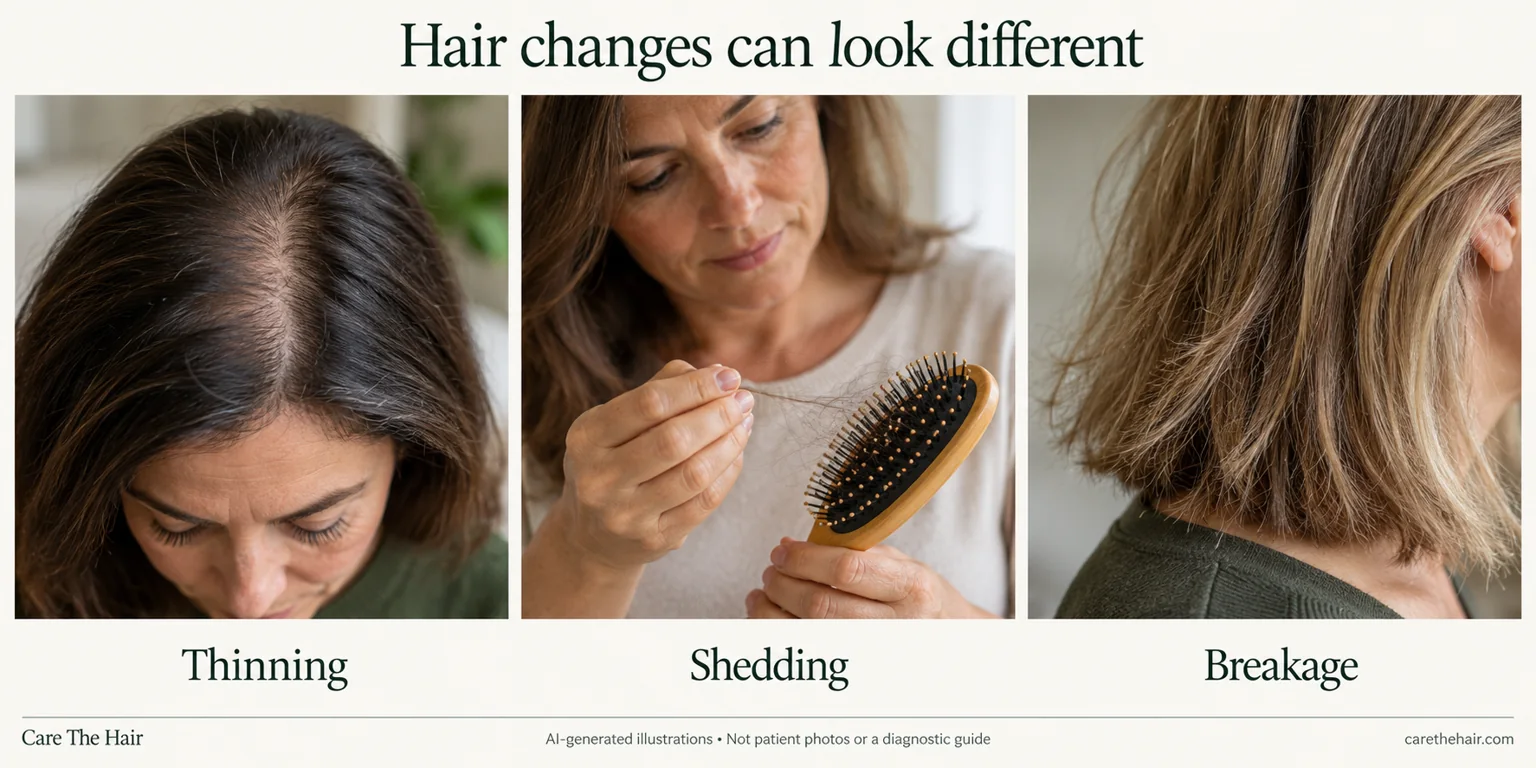
“Hair loss” can mean several different things. These clues help you describe what is happening; they are not a way to diagnose yourself.
| Change | A possible explanation | What to discuss |
|---|---|---|
| Gradual loss of coverage over the parting or crown | Female pattern hair loss | How long it has been changing and whether relatives have similar thinning |
| Increased shedding across the scalp | Telogen effluvium or another cause | Illness, weight changes, stress and medicines in the preceding months |
| Short, snapped strands after styling or chemical treatments | Hair-shaft damage | Heat, bleach, handling and whether the scalp is also affected |
| A receding frontal hairline, sometimes with eyebrow loss | A condition affecting the hairline, including possible scarring alopecia | Arrange prompt assessment, especially with redness, scaling or discomfort |
Several processes can happen together. Someone may have gradual pattern thinning and a temporary episode of shedding on top of it. Our 12-cause overview covers the wider range of explanations.
Gradual thinning: female pattern hair loss
In female pattern hair loss, affected follicles produce progressively finer, shorter hairs. The parting and top of the scalp are often involved, while the frontal hairline frequently remains preserved.
The British Association of Dermatologists describes a condition that usually progresses over years. Treatment may slow progression and partly restore coverage in some women; it is not a guaranteed return to previous density.
A useful appointment question is: “Does the pattern suggest female pattern hair loss, or could something else explain it?” Our dedicated guide explains its assessment and management.
Increased shedding: look back a few months
Telogen effluvium occurs when more hairs than usual move into the resting phase and later shed. Possible triggers include illness, surgery, substantial weight loss and significant stress.
Because shedding is delayed, a recent change in your hair may relate to something that happened months earlier. DermNet’s telogen effluvium guidance explains that timing.
Many cases improve after the trigger settles, although fullness takes longer to recover. Ongoing triggers or overlapping conditions can complicate that process. Being in perimenopause does not establish that hormone fluctuations caused the shedding.
For a fuller explanation, read our telogen effluvium guide.
Hairline or eyebrow loss needs a different conversation
Frontal fibrosing alopecia is a form of scarring hair loss often seen after menopause. It can affect the frontal hairline, the sides of the scalp and the eyebrows. Other people can develop it too.
Some people experience redness, scaling, itching or burning; others notice no discomfort. According to the British Association of Dermatologists, treatment aims to control further loss because follicles destroyed by scarring cannot produce hair again.
A receding hairline does not automatically mean you have this condition. It does mean the change should be assessed rather than managed with a succession of over-the-counter products.
What should a hair-loss assessment cover?
Your history matters as much as the timing of menopause. Mention heavy or prolonged periods, restrictive eating, significant weight changes, recent illness and any new or altered medication. Other symptoms—such as unexplained fatigue, new acne or rapidly changing facial hair—may help the clinician decide what to investigate.
An appointment usually includes examination of the scalp and questions about the onset and pattern. Tests for iron status, thyroid function or other suspected problems may be appropriate. Everyone does not need the same panel.
The American Academy of Dermatology’s diagnosis guidance describes how examination and, when indicated, blood tests or a scalp biopsy help establish the cause.
Before the appointment, write down:
- When you first noticed the change and whether it was gradual or sudden.
- Illnesses, operations, weight changes and stressful events in the preceding months.
- Your medicines and supplements, including HRT.
- Scalp symptoms and any eyebrow or body-hair changes.
A few photographs taken under similar lighting can help show progression. Include the emotional impact too. If the problem is affecting your confidence or daily life, that belongs in the discussion.
What can actually help menopause-related hair thinning?
The answer depends on the diagnosis. Treating a deficiency, managing a scalp disorder and treating pattern hair loss are different tasks.
Topical minoxidil: an established option for pattern loss
Minoxidil applied to the scalp is a commonly used treatment for female pattern hair loss. A Cochrane review found that women using it were more likely to experience regrowth than those using placebo. The evidence concerns female pattern hair loss, not every cause of thinning around menopause.
Patience and consistency matter. The AAD advises allowing roughly six to twelve months to judge the response. Early shedding can occur, and ongoing use is generally necessary to maintain benefits.
Possible problems include scalp irritation and unwanted facial hair. Products, instructions and approvals differ by country, so discuss the appropriate formulation with a clinician or pharmacist and follow its local instructions.
Minoxidil should be avoided during pregnancy, when planning pregnancy and while breastfeeding. Perimenopause does not necessarily rule out pregnancy. Sudden unexplained hair loss or an inflamed scalp should be assessed before self-treatment.
Prescription medicines: suitability matters
A dermatologist may consider medicines such as spironolactone or low-dose oral minoxidil for selected patients. Some prescribing is off-label, meaning the medicine is being used outside its licensed indication.
The decision depends on the diagnosis, medical history, other medicines and pregnancy considerations. It is worth asking why a particular treatment fits your situation and how its effects will be monitored.
Oral minoxidil, for example, can cause unwanted hair growth, dizziness, fluid retention or palpitations. This NHS patient information leaflet describes its precautions. A low dose does not make it suitable for everyone.
HRT: promising questions, limited hair-specific evidence
HRT is used to manage menopause symptoms. Whether it reliably improves hair loss is a separate question, with much less evidence behind it.
In a 2023 pilot study, 11 Japanese women receiving HRT were followed for six months. Researchers reported improvement in a frontal hairline score. The study had no control group, so it cannot show with confidence how much improvement was caused by the treatment.
That is a reason for further research, not a basis for promising regrowth.
The NHS’s treatment guidance places HRT decisions within an individual discussion of menopause symptoms, benefits and risks. Tell your prescriber about hair concerns, including changes after starting treatment. Do not start, stop or change HRT independently to try to manage them.
Supplements and procedures: ask what the evidence applies to
Correcting an identified deficiency may help when it contributes to shedding. Taking a supplement because its packaging mentions menopause does not establish that you need it.
The AAD warns that excessive amounts of certain nutrients can worsen hair loss. Biotin also interferes with some laboratory tests. Tell your clinician and laboratory what you take and follow their advice before testing.
If considering PRP injections or a device, ask:
- Was it studied in people with my diagnosis?
- What improvement is realistic, and how is it measured?
- What are the risks, maintenance requirements and full costs?
A treatment may have evidence for one condition without being useful for another.
Caring for your hair while you work out the cause
Gentle care can reduce additional damage. Use conditioner, detangle without tugging, limit excessive heat and avoid hairstyles that pull. These measures protect the strands you have; they do not treat every underlying cause.
Avoid crash diets and aim for regular, balanced meals. Starting several supplements and treatments together can make it difficult to tell what is helping or causing irritation.
For monitoring, choose occasional photographs in consistent lighting rather than checking repeatedly throughout the day. The purpose is to document change, not scrutinise every strand.
Cosmetic support is a valid choice too. A different cut, camouflage product or comfortable hairpiece may help you feel more at ease while waiting for results. You can discuss distress with your clinician even if you are undecided about medical treatment.
Three claims to be cautious about
“Thinning proves you have a hormone imbalance.”
Not necessarily. Many women with female pattern hair loss have normal androgen levels.
“A menopause shampoo reverses thinning.”
A product may improve texture, manageability or the appearance of fullness. That does not establish that it treats the follicle or scalp condition responsible.
“Nothing can help because it is ageing.”
Several causes can be treated or managed. Assuming nothing can be done may also delay recognition of a separate health problem.
Frequently asked questions
Can hair loss begin before menopause?
Yes, hair changes can occur during perimenopause. Female pattern hair loss can also begin earlier in life. The timing helps describe the problem but does not confirm its cause.
Will my hair grow back after menopause?
There is no single answer. Temporary shedding may improve when the trigger resolves. Pattern thinning may respond to ongoing treatment. Hair cannot regrow from follicles that have been destroyed by scarring.
Should I have my hormones tested?
Not automatically. Testing should follow the symptoms and examination. A broad commercial hormone panel may not answer why your hair is thinning.
Does seeing hair during washing mean I should wash less?
Washing can make shed hairs easier to notice. Reducing washing does not treat the cause of hair loss. Use a gentle routine suited to your scalp and seek advice for persistent changes.
When should I arrange an appointment?
For persistent shedding, gradual loss of coverage or any change that concerns you. Seek prompt assessment for new patches, scalp pain or inflammation, or hairline recession with eyebrow loss. You do not need to wait for a supplement to fail first.
Where to start
Menopause may contribute to hair changes, but age alone cannot identify the treatment you need. Establish what kind of loss is occurring, check relevant contributing factors and discuss options with realistic expectations.
Keep a short history, bring your medication list and ask what the assessment suggests. That gives you a clearer basis for deciding what to try—and what you can leave on the shelf.
General educational information; not a personal diagnosis or prescription.
Read next
- Female pattern hair loss — a closer look at gradual thinning.
- Telogen effluvium — understanding temporary shedding.
- Why is my hair falling out? — the broader range of possible causes.