
Hair Growth Science
Rosemary Oil vs Minoxidil: Which Is Better for Hair Growth?
Rosemary oil has become one of the most talked-about hair growth remedies online. Scroll through social media, and you will find people claiming it can regrow hair just as well as minoxidil.
Some even suggest replacing minoxidil with rosemary oil because it is natural.
But how much of this is supported by science?
Interestingly, there is a real clinical study comparing the two. It found encouraging results for rosemary oil, but the findings are often misunderstood.
If you are dealing with hair thinning or pattern hair loss, understanding the difference matters.
Let’s look at what the research actually says, how both treatments compare, and what you should know before trying either one.
Rosemary Oil vs Minoxidil: What Is the Difference?
Minoxidil has stronger scientific evidence for treating pattern hair loss. Rosemary oil has shown promise in a small clinical trial, but much more research is needed.
Minoxidil is an established hair-loss medicine. Rosemary oil is a plant-based product being investigated for possible hair-growth benefits.
Here is a quick comparison.
| Feature | Rosemary oil | Topical minoxidil |
|---|---|---|
| What is it? | Essential oil from the rosemary plant | Medicine available as scalp foam or solution |
| Hair-growth evidence | Limited human studies | Supported by numerous clinical studies |
| Proven treatment for pattern hair loss? | Not established | Yes |
| When might results appear? | Improvement measured at six months in one trial | Often takes several months |
| Possible side effects | Scalp irritation, allergic reactions | Itching, dryness, irritation, unwanted hair growth |
| Long-term results | Uncertain | Continued use is usually needed |
Both deserve a closer look, especially because one study has generated so much attention.
Does Rosemary Oil Really Help Hair Growth?
Rosemary is a familiar herb used in cooking and traditional remedies.
Its essential oil contains natural compounds that researchers have investigated for their possible effects on inflammation, skin biology and hair growth.
You may have heard that rosemary oil increases scalp circulation or blocks DHT, a hormone involved in pattern hair loss.
These ideas have some basis in laboratory research. However, that does not mean rosemary oil has been proven to block DHT or regrow hair in people through those mechanisms.
Human clinical studies are needed to establish whether a treatment works.
The most widely discussed research on rosemary oil and hair growth was published in 2015.
What did the 2015 rosemary oil vs minoxidil study find?
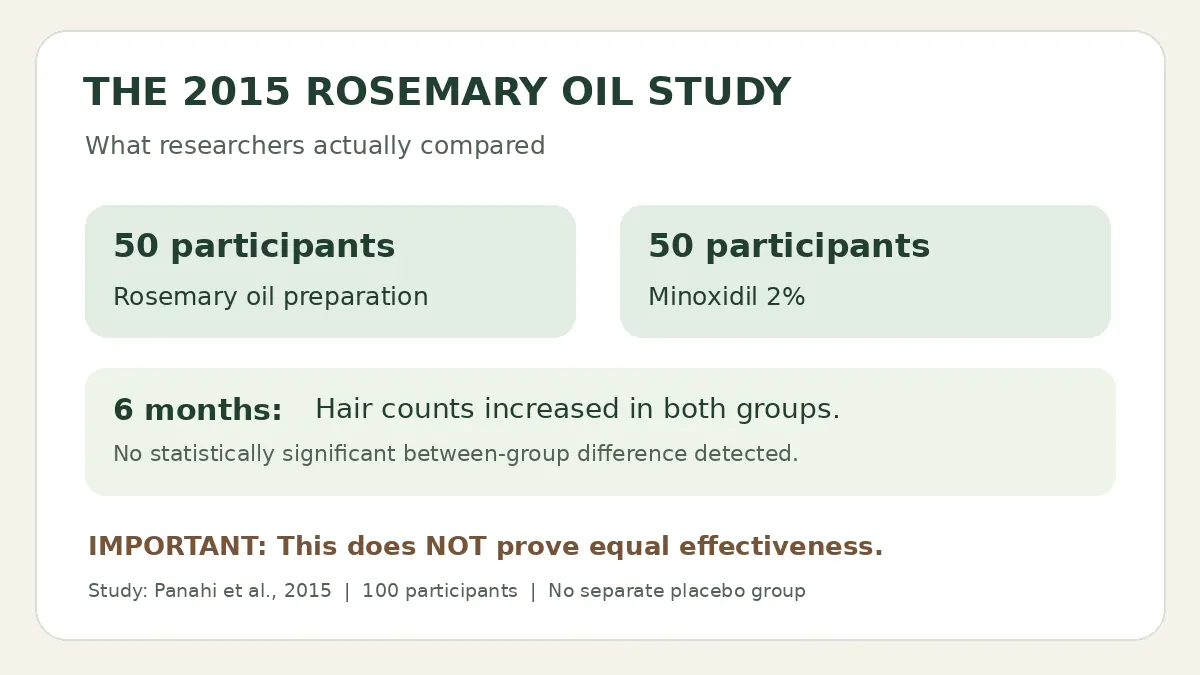
Researchers compared rosemary oil with 2% minoxidil in 100 people with androgenetic alopecia, also known as pattern hair loss.
The participants were divided into two groups:
- 50 used a rosemary oil preparation.
- 50 used 2% minoxidil.
Hair counts were measured at the beginning, after three months and after six months.
The results were interesting.
After three months: Neither group showed a statistically significant increase in hair counts.
After six months: Both groups had a statistically significant increase in hair counts compared with the beginning of the study.
The researchers did not find a statistically significant difference in hair counts between the groups at six months.
You can read the study here: Rosemary Oil vs Minoxidil 2% — Panahi et al., 2015.
So, does this mean rosemary oil works just as well as minoxidil?
Not quite.
Why the study does not prove they are equally effective
There are three important limitations.
First, the study compared rosemary oil with 2% minoxidil, not 5% minoxidil.
Second, it involved only 100 participants and lasted six months. Larger studies are needed to understand how reliable the benefits are.
Third, there was no separate placebo group. This makes it harder to determine how much of the improvement was caused by each treatment.
Most importantly, finding no statistically significant difference does not prove that two treatments are equally effective.
That would require research specifically designed to establish equivalence.
A later scientific review of non-prescription treatments for androgenetic alopecia also highlights the limited evidence available for rosemary oil.
The study gives us a reason to investigate rosemary oil further. It does not establish it as a replacement for minoxidil.
Is Rosemary Oil as Effective as 5% Minoxidil?
This is one of the biggest misunderstandings online.
The famous rosemary oil study used 2% minoxidil. It did not compare rosemary oil with 5% minoxidil.
Therefore, we cannot use its findings to claim that rosemary oil is equally effective as 5% minoxidil.
Minoxidil has been studied much more extensively. Both 2% and 5% topical formulations are used for suitable patients with pattern hair loss, depending on the product and treatment plan.
According to the American Academy of Dermatology, minoxidil is an established treatment for female pattern hair loss. Research also supports its use for male pattern hair loss.
Rosemary oil may be promising, but it does not yet have the same level of evidence.
How Does Minoxidil Help Hair Grow?
Minoxidil is a medicine applied directly to the scalp.
Scientists are still studying every detail of how it works, but research suggests it affects the hair-growth cycle and helps some hair follicles produce thicker, longer-growing hairs.
It is commonly used for androgenetic alopecia, which causes gradual thinning in men and women.
However, minoxidil does not work for everyone.
It also does not cure pattern hair loss. Benefits usually depend on continued treatment.
The American Academy of Dermatology notes that it can take six to twelve months to assess how well minoxidil is working.
Some people also notice temporary increased shedding during the early weeks of treatment.
For more information, read our guide to Minoxidil for Women, including expected results and possible side effects.
How Long Does Rosemary Oil Take to Grow Hair?
If you have seen a video promising thicker hair after two weeks of rosemary oil, be cautious.
The available clinical evidence does not support such a precise claim.
In the 2015 trial, the researchers found no significant improvement in hair counts after three months. Improvement was measured after six months.
That does not mean everyone will notice results after exactly six months.
We still do not know how many people respond, which rosemary formulations may work best, or whether any improvement continues over the long term.
For both treatments, hair growth is gradual.
Taking photographs under the same lighting, with the same hairstyle and parting, can help you monitor changes more reliably than judging your hair every day.
Rosemary Oil vs Minoxidil: Which Has More Side Effects?
Both can cause scalp irritation, although their safety profiles are not identical.
Rosemary oil side effects
Rosemary essential oil is highly concentrated.
Applying it directly to the scalp without proper dilution can cause irritation. Essential oils can also trigger allergic contact dermatitis in some people.
Possible symptoms include:
- Itching or burning.
- Redness or inflammation.
- A rash or irritated scalp.
The DermNet guide to essential-oil allergies explains why concentrated essential oils should not be applied directly to the skin.
Also, not every product labelled “rosemary oil” contains the same ingredients or concentration.
A ready-made cosmetic hair oil is different from pure rosemary essential oil.
Minoxidil side effects
Topical minoxidil can cause:
- Scalp dryness or itching.
- Redness and irritation.
- Temporary increased shedding.
- Unwanted hair growth outside the treated scalp.
Rare but more serious symptoms can include dizziness, chest discomfort, a fast heartbeat or swelling. These require prompt medical attention.
The 2015 comparison trial reported scalp itching in both treatment groups, with more itching in the minoxidil group.
However, one small study is not enough to conclude that rosemary oil is safer overall.
If you experience a persistent reaction to either product, stop using it and seek appropriate medical advice.
Minoxidil should also be avoided during pregnancy or when planning pregnancy. Breastfeeding requires individual medical advice because guidance differs according to formulation and circumstances.
Can You Use Rosemary Oil and Minoxidil Together?
Many people ask whether combining rosemary oil and minoxidil will produce faster hair growth.
It is an understandable question.
But there is not enough reliable clinical evidence to say that combining them produces better results.
Using several scalp products together may also increase irritation.
Do not add essential oil directly to a bottle of minoxidil or change how your medicine is applied without professional guidance.
If you already use minoxidil and want to introduce a rosemary product, discuss it with a dermatologist or pharmacist.
Adding a new product should not interfere with a treatment that is already helping you.
Can Rosemary Oil Replace Minoxidil?
Based on current evidence, rosemary oil should not be considered a proven substitute for minoxidil.
If minoxidil is working for you, stopping it may cause the benefits to fade over time.
Rosemary oil has not been shown to maintain those benefits.
There is another important point: not every type of hair loss needs the same treatment.
Gradual thinning from pattern hair loss is different from sudden shedding after illness, iron deficiency or a thyroid condition.
If the cause is unclear, choosing between rosemary oil and minoxidil may not be the most useful first step.
Our guide, Why Is My Hair Falling Out?, explains common causes and when to seek assessment.

Is Rosemary Oil Worth Trying?
Rosemary oil has attracted attention for a reason. Early clinical evidence suggests it deserves further research.
But there is a difference between something that might help and a treatment that has been tested extensively.
If you have confirmed pattern hair loss, minoxidil currently has stronger evidence.
If you are interested in rosemary oil, be realistic about its limitations. Avoid undiluted essential oils, choose carefully formulated products and stop if irritation develops.
Do not delay assessment of noticeable or progressing hair loss while relying only on unproven treatments.
A dermatologist can help you understand the cause and discuss suitable options.
Frequently Asked Questions
Is rosemary oil better than minoxidil for hair growth?
There is not enough evidence to show that rosemary oil is better. Minoxidil has stronger clinical research supporting its effectiveness for pattern hair loss.
Does rosemary oil really regrow hair?
One small clinical trial found increased hair counts after six months. However, larger and better-controlled studies are needed to confirm its benefits.
Is rosemary oil as good as 5% minoxidil?
This has not been established. The widely shared 2015 study compared rosemary oil with 2% minoxidil, not 5%.
Can I use rosemary oil and minoxidil together?
There is insufficient evidence that combining them improves hair growth. Ask a dermatologist or pharmacist before adding rosemary oil to your treatment routine.
Can I stop minoxidil and switch to rosemary oil?
Rosemary oil has not been proven to preserve minoxidil’s benefits. Stopping minoxidil can lead to renewed thinning. Discuss treatment changes with your clinician.
Does rosemary oil block DHT?
There is insufficient human clinical evidence to claim that applying rosemary oil reliably blocks DHT in the scalp. Learn more in our guide to DHT and Hair Loss.
Final Thoughts: Which One Should You Choose?
Rosemary oil and minoxidil may appear similar in online comparisons, but the scientific evidence behind them is very different.
Rosemary oil has some encouraging early research. Minoxidil has been studied far more thoroughly and remains an established treatment for pattern hair loss.
Remember these three points:
- The well-known rosemary study compared it with 2% minoxidil, not 5%.
- The study did not prove that the treatments are equally effective.
- The best treatment depends on why you are losing hair, not which product is trending.
Hair growth takes time, and no product guarantees results.
Understanding the evidence helps you make better decisions without relying on exaggerated promises.
Read Next
- Minoxidil for Women: Benefits, Side Effects and Results
- DHT and Hair Loss Explained
- PRP for Hair Loss: Benefits, Side Effects and What to Expect
References
- Panahi Y, et al. (2015). Rosemary oil vs minoxidil 2% for the treatment of androgenetic alopecia: A randomized comparative trial. SKINmed.
- Do Non-Prescription Products Help in Managing Androgenic Alopecia?. Skin Appendage Disorders.
- American Academy of Dermatology. Female Pattern Hair Loss: Diagnosis and Treatment.
- American Academy of Dermatology. Hair Loss: Diagnosis and Treatment.
- DermNet. Allergic Contact Dermatitis to Essential Oils.
- Olsen EA, et al. (2025). Summation and Recommendations for the Safe and Effective Use of Topical and Oral Minoxidil. Journal of the American Academy of Dermatology.
Care The Hair publishes research-backed educational articles. This content does not replace personalised medical advice or diagnosis.