
Hair Growth Science
Scalp Massage for Hair Growth: Benefits, Research and Technique
You have probably seen the videos. Someone massages their scalp, shows their long hair, and tells you that a few minutes a day made the difference.
It sounds appealing. There is no prescription to collect and no expensive bottle to replace. But does scalp massage for hair growth actually work?
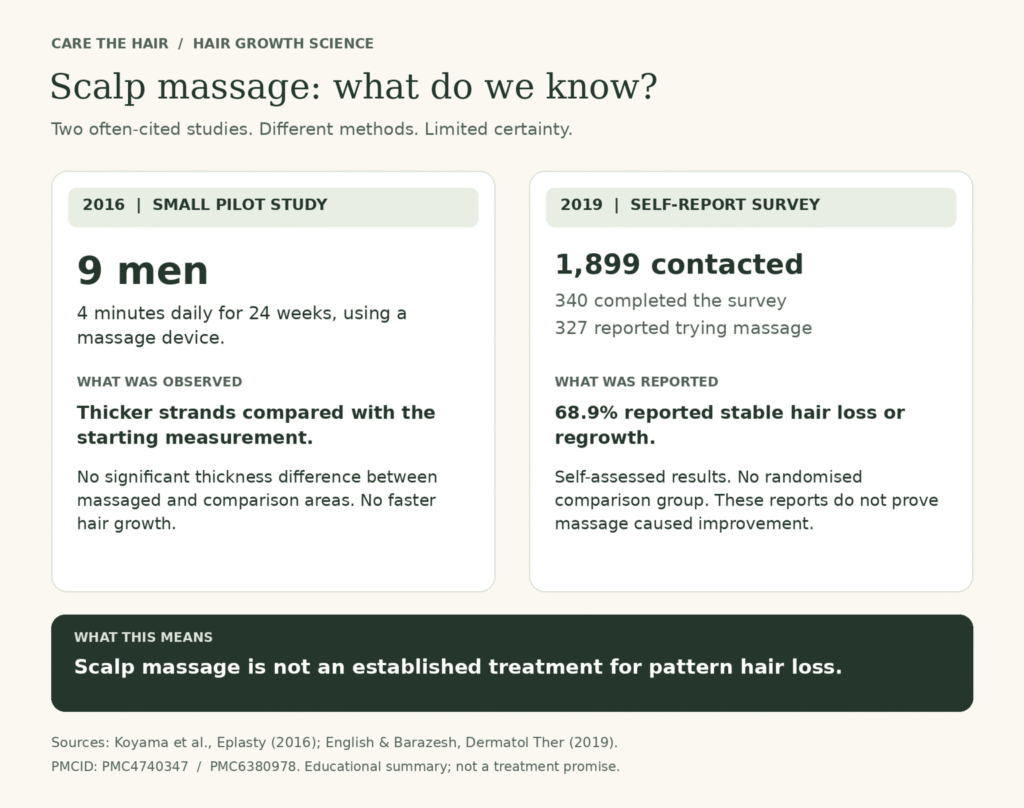
The evidence is limited. A small study found an increase in hair strand thickness, but it did not show faster hair growth. Scalp massage has not been established as a treatment for pattern hair loss. [1],[2]
That does not mean you cannot enjoy it. It means the promises need to match the research.
Does scalp massage help hair growth?
Two studies often appear in discussions about scalp massage. They answer different questions.
The 2016 study: hair thickness, not faster growth
Researchers studied nine healthy men without obvious hair loss. A device massaged one scalp area for four minutes daily over 24 weeks. Another area served as a comparison.
Average strand thickness increased from 0.085 mm to 0.092 mm in the massaged area compared with its starting measurement. However, thickness did not differ significantly between the massaged and comparison areas. Hair growth rate did not improve.
This was a small exploratory study. Its findings cannot tell us whether massage treats thinning hair in the wider population. [1]
The 2019 survey: encouraging reports with important limits
A later study contacted 1,899 people who had purchased scalp massage instructions. Of these, 340 completed a survey. Among the 327 who tried massage, 68.9% reported that their hair loss had stabilised or that hair had regrown.
That figure is often presented as a success rate. It was actually a result reported by a small, self-selected group of respondents.
There was no randomised comparison group. Hair changes were mainly self-assessed, and some people used other treatments. One author also sold the massage materials.
The survey raises a research question. It does not establish that massage caused the reported improvements. [2]
How might scalp massage affect hair follicles?
One proposed mechanism is mechanotransduction. This means cells respond to physical forces by changing their activity.
Laboratory work found that stretching cultured dermal papilla cells changed gene expression. These cells help regulate hair follicles. However, laboratory findings do not prove that a home massage routine produces visible regrowth. [1]
You may also hear that massage “boosts circulation” or “wakes up dormant follicles”. These phrases can make a possible mechanism sound like a proven result.
A useful question is: Did the treatment improve people’s hair in a reliable clinical study?
For scalp massage, that answer remains uncertain.
Our guide to the hair growth cycle explains what happens inside a growing, resting and shedding follicle.
How to do scalp massage gently
If your scalp is healthy and you enjoy massage, keep the routine comfortable. The following is a cautious self-care approach. It is not a clinically validated hair regrowth protocol.
1. Start with clean hands and detangled hair
Remove rings that might catch your hair. Sit comfortably and let your shoulders relax.
Dry, detangled hair may be easier to handle without pulling. You do not need oil or a special tool.
2. Use your fingertips
Rest the pads of your fingers against your scalp. Keep your nails away from the skin.
Make small, slow movements with light pressure. Avoid dragging your fingers through the lengths or tugging at the roots.
3. Move around the scalp
Lift your fingers and place them on the next area. Work across the sides, crown and back at a comfortable pace.
Do not repeatedly rub a thinning patch or press harder because an area has less hair.
4. Keep it brief
You can start with a minute or two to see whether it feels comfortable. Stop sooner if it does not.
There is no established best duration for hair regrowth. Longer sessions and stronger pressure have not been shown to guarantee better results.
5. Check how your scalp feels afterwards
Pain, burning, scratches or lasting tenderness are reasons to stop. Redness is not a target to aim for.
If you have been given instructions for a scalp condition or procedure, follow those instructions instead.
The aim is a comfortable experience. You should not have to tolerate soreness to complete it.
Can scalp massage cause hair loss?
Rough handling can damage fragile hair. Pulling, scratching and repeated friction can also make a massage uncomfortable.
An NHS hospital hair-care leaflet specifically advises people with thinning or falling hair to avoid scalp massage during washing because it can pull on the hair. Wet hair needs particularly gentle handling. [3]
If you notice more breakage or shedding when you massage, stop and review the routine. Do not assume that every lost hair is a harmless “purge” or evidence that new growth is coming.
The American Academy of Dermatology recommends gentle care for people with hair loss. This includes a gentle shampoo, conditioner and avoiding hairstyles that pull on the hair. [4]
Our traction alopecia guide explains how repeated tension can affect the hairline.
Are scalp massagers better than fingertips?
A tool may feel pleasant or make massage easier for someone whose hands tire. That does not establish a hair growth advantage.
The small device study cannot be used to support every silicone brush, vibrating comb or electric massager on sale.
If you choose a tool, avoid sharp or rigid points. Keep it clean and stop if it catches your hair or irritates your skin. Follow the manufacturer’s cleaning instructions.
A dermaroller is different. It punctures the skin and should not be treated as an ordinary massage tool. Ask a dermatologist before trying microneedling for hair loss. [5]
Do you need oil for scalp massage?
No product is necessary for the gentle routine above.
Adding an oil or serum introduces another variable. If your scalp becomes itchy or irritated, it can be harder to know whether the product, friction or both caused the problem.
There is also no reason to combine several new products at once. A simpler routine is easier to assess.
If you use a prescribed scalp treatment, ask your clinician how massage fits around it. Do not mix products together or assume that massage improves their absorption.
Can scalp massage replace minoxidil?
Scalp massage should not replace treatment recommended for a diagnosed hair-loss condition.
Minoxidil is an established option for certain types of hair loss. It does not suit every cause, and it needs to be used as directed. Massage has not been shown to offer equivalent results. [5]
The first step is understanding why your hair is changing. Gradual pattern thinning, sudden shedding and a new bald patch may need different approaches.
If you are unsure where to start, read Why Is My Hair Falling Out?.
When should you see a dermatologist?
Arrange an assessment if you have:
- Sudden or patchy hair loss.
- Persistent or worsening shedding.
- Scalp pain, burning or significant itching.
- Redness, sores, crusting or marked scaling.
- A receding hairline or widening part that continues to progress.
A dermatologist can examine your scalp and decide whether tests are needed. Treating the cause matters more than choosing a massage technique. Early treatment can also be important for conditions that cause permanent loss. [5]
Avoid massaging sore, broken or inflamed skin while waiting for advice. After a hair transplant or another scalp procedure, use only the care routine your treating team recommends.
FAQ
How often should I massage my scalp for hair growth?
There is no proven schedule that guarantees regrowth. If you enjoy gentle massage and your scalp tolerates it, choose a brief routine that feels comfortable. Stop if it causes irritation.
How long does scalp massage take to work?
There is no reliable treatment timeline. The small study lasted 24 weeks, but that does not mean everyone will see results after six months. Do not delay an assessment while waiting for massage to work.
Is daily scalp massage safe?
It depends on your scalp and how you do it. Gentle handling is important. Daily rubbing may be unsuitable if your hair is fragile or your scalp is sore, inflamed or affected by a skin condition.
Does scalp massage block DHT?
It has not been established as a DHT-blocking treatment. Be cautious about claims that pressing or stretching the scalp reverses the hormonal process behind pattern hair loss.
Should scalp massage hurt?
No. Stop if it hurts, burns or leaves lasting tenderness. More pressure is not a proven route to more hair.
Is scalp massage worth trying?
If you enjoy it, a brief, gentle massage can be a personal care habit. Keep your expectations modest and pay attention to how your scalp responds.
You do not need an expensive device or an uncomfortable routine to take care of your hair. If thinning or shedding is worrying you, finding the cause is the more useful next step.
Read Next
- How Fast Does Hair Grow? Monthly Growth Explained
- Biotin for Hair Growth: Does It Really Work?
- Why Is My Hair Falling Out? 12 Causes and What to Do
References
- Koyama T, et al. Standardized Scalp Massage Results in Increased Hair Thickness by Inducing Stretching Forces to Dermal Papilla Cells in the Subcutaneous Tissue. Eplasty. 2016;16:e8. Read the study.
- English RS Jr, Barazesh JM. Self-Assessments of Standardized Scalp Massages for Androgenic Alopecia: Survey Results. Dermatology and Therapy. 2019;9:167–178. Read the study.
- Gloucestershire Hospitals NHS Foundation Trust. Good hair care advice. Read the guidance.
- American Academy of Dermatology. Hair loss: Tips for managing. Read the guidance.
- American Academy of Dermatology. Hair loss: Diagnosis and treatment. Read the guidance.
This article provides general education. It cannot diagnose the cause of hair loss or replace individual medical advice.