
Hair Growth Science
How Fast Does Hair Grow? Monthly Growth Explained
In this guide
- How much does hair grow in a month?
- Where does hair growth happen?
- Why does my hair seem to stop growing?
- What affects hair growth?
- Can you make your hair grow faster?
- Does cutting your hair make it grow faster?
- How can you track hair growth without getting frustrated?
- When should you speak to a doctor?
- FAQ
- Give your hair a realistic timeline
You have been growing your hair for months. You have changed your shampoo, tried a new oil, and resisted the urge to cut it. Yet it still seems to sit at the same length.
Is your hair growing slowly? Or is something happening to the length you have already grown?
Scalp hair usually grows around 1 centimetre a month. You will also see this rounded to about half an inch. These are useful estimates, but your own hair will not follow an exact monthly schedule.
Understanding your hair growth rate can save you a lot of frustration. It can also help you spot the difference between slow growth, hair breakage, and hair loss.
How much does hair grow in a month?
A useful starting point is about 1 centimetre of scalp hair growth per month. Research has found considerable variation between people. A study of 2,249 young adults also found differences across scalp areas and participant groups. There is no single growth rate that fits everyone. [1] [2]
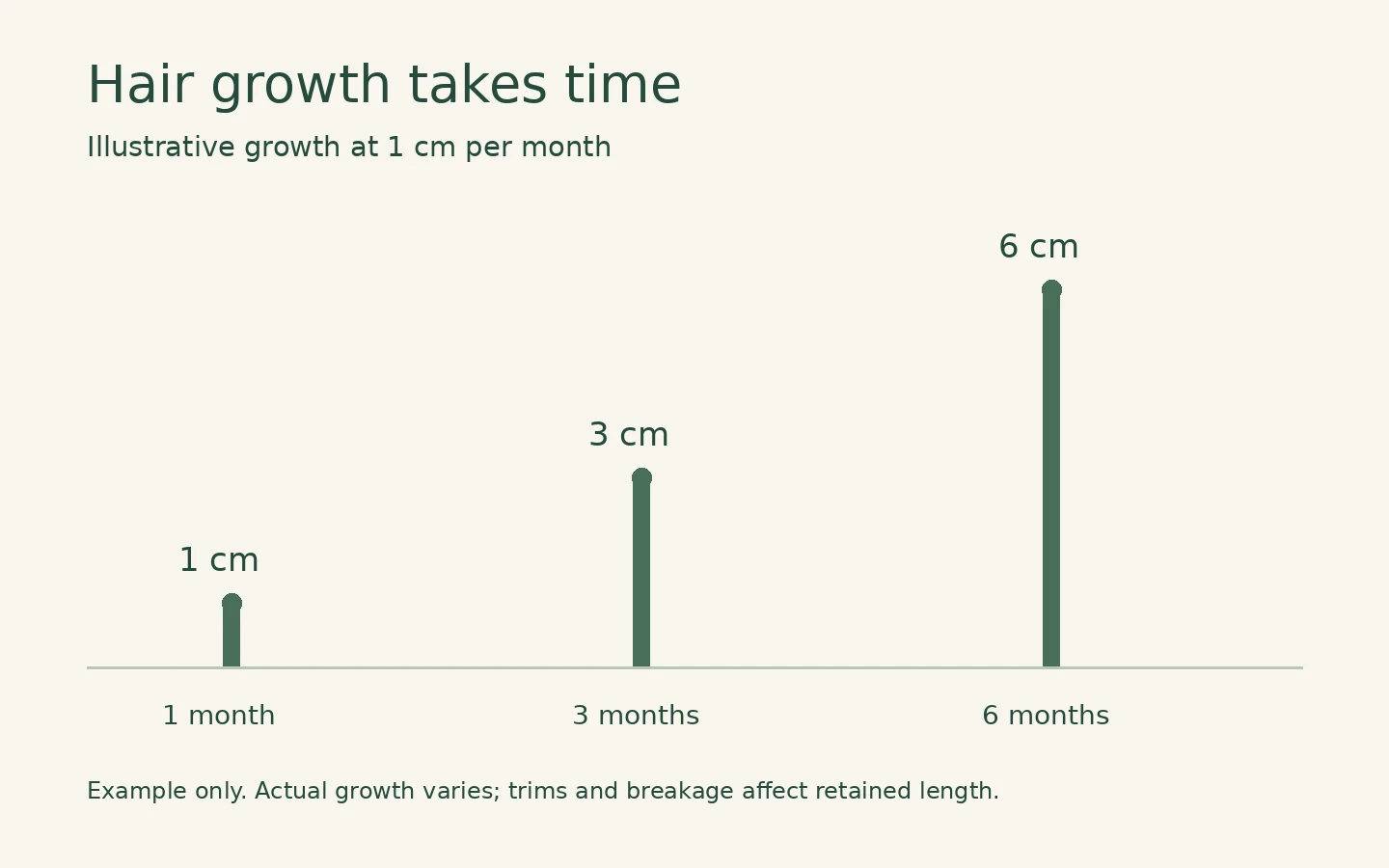
Here is what growth could look like using 1 centimetre per month as a simple example:
| Time | Estimated new hair growth |
|---|---|
| 1 month | About 1 cm |
| 3 months | About 3 cm |
| 6 months | About 6 cm |
| 12 months | About 12 cm |
These figures describe new growth at the scalp. They do not account for trims, breakage, or hairs reaching the end of their growth phase.
That is why growing 6 centimetres of new hair does not always make your hairstyle look 6 centimetres longer.
Where does hair growth happen?
Hair grows inside a hair follicle, a small structure beneath the skin.
Cells near the base of the follicle multiply and help form the hair shaft. The strand you can see is mainly made of keratin, a strong structural protein.
Each follicle follows a hair growth cycle:
- Anagen: The active growth phase.
- Catagen: A short transition phase.
- Telogen: The resting phase.
Old hairs are eventually released as the cycle continues. Your follicles do not all follow the same timetable, so your whole head does not shed and regrow at once.
For a closer look at these stages, read our Hair Growth Cycle guide.
Two things matter when you want longer hair: how quickly a strand grows and how long it stays in its growth phase. The condition of the strand matters too. It needs to survive everyday washing, styling, and brushing.
Why does my hair seem to stop growing?
When your hair stays at the same length, the follicle may still be producing new hair. The problem can be happening further down the strand.
Hair breakage can cancel out your growth
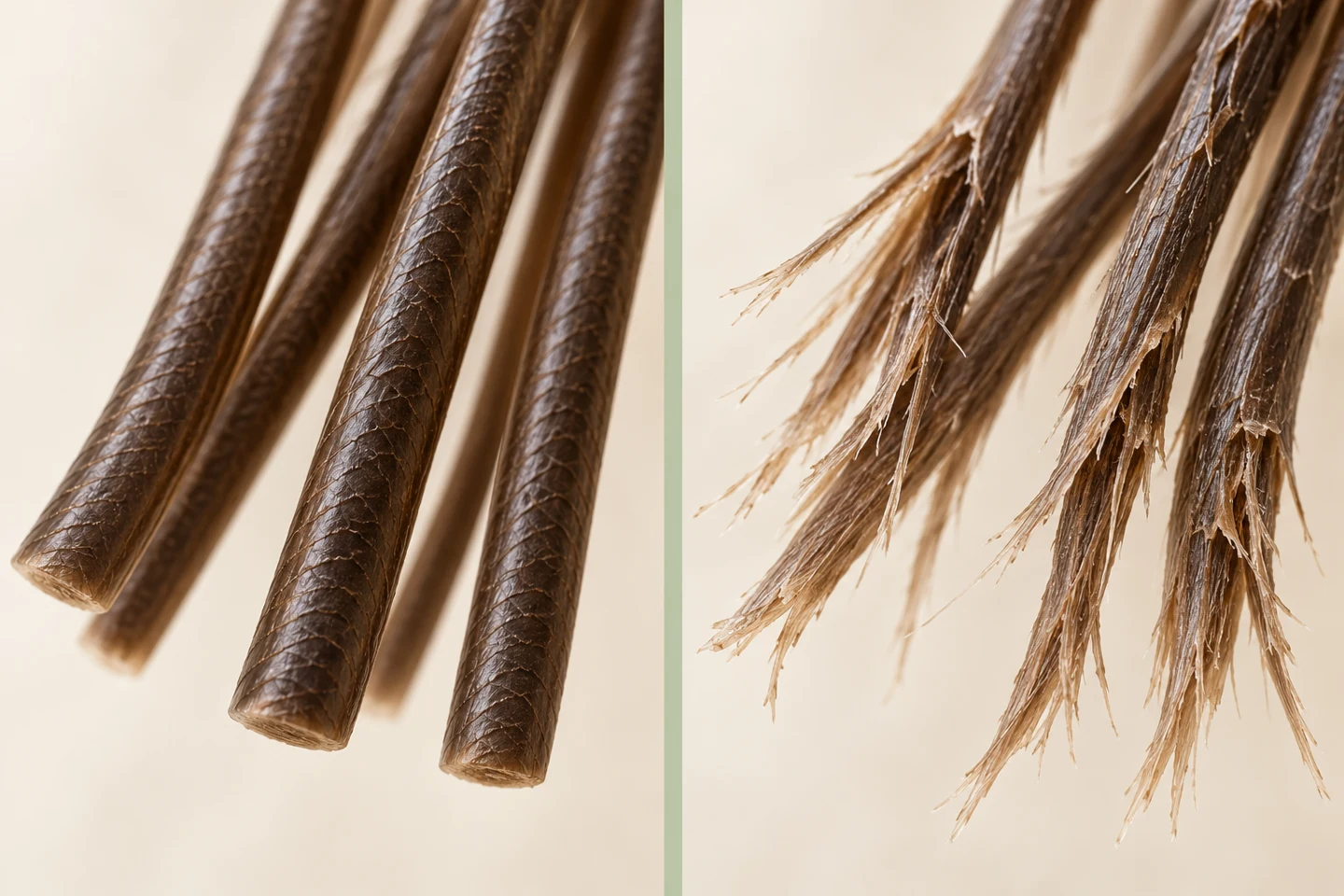
Imagine that your hair grows about 1 centimetre this month. During the same month, damaged ends break off.
You have produced new hair, but you may see little change in overall length.
Repeated heat styling, bleaching, rough handling, and pulling can damage the hair shaft. Conditioner and gentler care can help reduce this damage. [3] [4]
Short, uneven pieces and frayed ends can suggest breakage. However, short hairs can also be new growth. One strand alone cannot tell you what is happening.
Curls can hide changes in length
Curly and coily hair bends and coils back towards the scalp. New length may be difficult to notice when you judge it only by where the ends sit.
For a fairer comparison, check the same small section in the same condition each month. Comparing wet, stretched hair with dry curls can make progress look very different.
Hair shedding can change how full your hair looks
Length and fullness are separate things.
Your remaining hairs may continue to grow while increased shedding makes your ponytail feel thinner. This can happen with conditions such as telogen effluvium.
A widening part, a receding hairline, or new bald patches also needs a different explanation from ordinary slow length gains.
If you are seeing these changes, our guide to why your hair may be falling out is a useful place to begin.
What affects hair growth?
Your hair growth rate is only one part of the picture. Health, the growth cycle, and damage can all affect the hair you see.
Your natural growth pattern
People differ in hair growth rate, strand thickness, density, and growth-phase length. Comparing your progress with someone else’s monthly photos can give you unrealistic expectations.
Even hairs on the same head do not behave identically. The large study mentioned earlier found variation between scalp areas as well as between people. [1]
Age and hormonal changes
Hair can change with age. Some people notice slower growth or thinner strands.
Hormonal conditions can affect hair too. For example, thyroid disease can cause hair changes, while androgen-related hair loss can gradually produce finer hairs in affected follicles. These problems may first look like “my hair is not growing properly.” [7]
Our guides to thyroid hair loss and DHT and hair loss explain these conditions in more detail.
Nutrition and recent illness
Hair needs adequate nutrition. Too little protein or certain nutrient deficiencies can contribute to hair loss.
Major illness, rapid weight loss, and other physical stresses can also trigger increased shedding. The change may appear months after the event, which makes the connection easy to miss. [7] [9]
This does not mean everyone with slow-growing hair needs blood tests or supplements. A clinician can assess your symptoms and decide whether testing would be useful.
Can you make your hair grow faster?
There is no reliable way to promise several extra centimetres of growth in a few weeks.
The useful approach depends on the problem. Damaged ends need gentler care. A nutrient deficiency needs proper assessment and correction. A hair loss condition may need treatment.
Those are different situations. The same “hair growth routine” will not solve all of them.
Protect the length you already have
For many people, reducing breakage is a practical place to start.
The American Academy of Dermatology recommends gentle hair care, conditioning, and reducing damaging styling habits. [3]
Try these changes:
- Use conditioner after shampooing.
- Detangle gently instead of pulling through knots.
- Reduce frequent high-heat styling.
- Give your hair a break from repeated bleaching or other harsh processing.
- Choose hairstyles that do not pull tightly.
- Handle your hair gently when drying it.
You do not need to replace your entire bathroom shelf. Start with the habit that puts the most stress on your hair.
If your hairstyle hurts or pulls at your hairline, read our guide to traction alopecia.
Eat enough rather than chasing one “hair food”
A varied diet with enough energy and protein supports normal hair production.
Include protein sources that suit your diet, such as beans, lentils, eggs, fish, dairy, tofu, or meat. Avoid assuming that one food or drink will dramatically change your growth rate.
If you have persistent shedding alongside a restricted diet, unexplained weight changes, or other symptoms, discuss it with a healthcare professional.
Be careful with hair growth supplements
Biotin is often sold as a shortcut to longer hair. However, biotin deficiency is uncommon, and taking extra biotin without a deficiency has no established benefit for hair growth.
High-dose biotin can also interfere with some blood tests, including thyroid tests. Tell your clinician about any supplements you take before testing. [5]
Iron and zinc supplements also need a reason. The American Academy of Dermatology advises taking these for hair loss when testing shows a deficiency. More is not automatically better. [6]
Get the right treatment if you have hair loss
Some treatments can help particular hair loss conditions. They are chosen according to the diagnosis, your health, and other factors.
A treatment that helps pattern hair loss may not address breakage or a scalp infection. A dermatologist can help identify the cause and explain which options are suitable. [6]
Does cutting your hair make it grow faster?
No. Cutting the ends does not speed up growth inside the follicle.
A trim can remove split or damaged ends. This can make your hair look neater and help you manage damage. But it does not send a signal to the root to produce hair faster.
The American Academy of Dermatology makes this distinction clear: hair growth happens beneath the skin, beyond the reach of a haircut. [8]
Choose trims according to the condition of your ends and your preferred style. You do not need to cut healthy length on a rigid schedule to “activate” growth.
How can you track hair growth without getting frustrated?
Checking every morning is unlikely to show much. A monthly comparison is more useful.
- Choose one small section. Use the same location each time.
- Keep the conditions similar. Compare dry hair with dry hair, for example.
- Take a photo in similar lighting. Keep your head position and camera distance consistent.
- Note trims and chemical treatments. These can change the result.
- Look at several months together. One photo can be misleading.
For curly hair, use the same gentle stretching method each time if you want to compare length. Avoid pulling hard.
These checks can help you notice a trend. They cannot diagnose a hair loss condition.
When should you speak to a doctor?
Arrange an assessment if you notice:
- Sudden or persistent heavy shedding.
- A widening part or a receding hairline.
- New bald patches.
- Scalp pain, marked itching, redness, or scaling.
- A clear change in your hair alongside other health symptoms.
Hair loss has many possible causes. Early assessment can help you find the cause and avoid spending months on products that do not address it. [3] [7]
You do not need to wait for a particular amount of hair loss before asking for help.
FAQ
How much does hair grow in a week?
Using 1 centimetre per month as a rough guide, that works out at around 2–3 millimetres per week. This is an estimate, not a target your hair must meet.
How long does it take to grow hair by 10 centimetres?
At 1 centimetre per month, it would take about 10 months to produce that amount of new growth. Keeping all that length depends on breakage and trimming. Your own growth rate may differ.
Does curly hair grow more slowly than straight hair?
Curl pattern alone cannot tell you an individual’s growth rate. Curly hair can also hide length gains because of shrinkage. Research shows substantial variation in human hair growth, so appearance is not a reliable growth-speed test. [1]
Will biotin make my hair grow faster?
Biotin may help when a genuine deficiency is affecting hair. Extra biotin has no established growth benefit for someone who is not deficient, and high doses can interfere with blood tests. [5]
Why is my hair getting longer but looking thinner?
Length and density can change separately. Some strands may keep growing while you lose more hairs or develop finer strands. A widening part or a noticeable reduction in fullness deserves assessment.
Can I grow several inches of hair in one month?
That is far beyond typical scalp hair growth. Be cautious with products or routines that promise it. Progress photos can also look different because of styling, extensions, lighting, or how the hair is stretched.
Give your hair a realistic timeline
Growing longer hair takes time. A few weeks may bring very little visible change, even when your follicles are working normally.
Focus on gentle care and watch your progress over several months. If your hair is becoming thinner, shedding heavily, or changing suddenly, get the cause checked.
You may need patience. You may need to protect your ends. Or you may need help with a hair loss condition. Knowing which situation you are dealing with is more useful than buying another product that promises faster growth.
This article is for educational purposes. It does not replace an individual medical assessment.
References
- Loussouarn G, et al. Diversity in human hair growth, diameter, colour and shape. European Journal of Dermatology. 2016;26(2):144–154. View study.
- LeBeau MA, Montgomery MA, Brewer JD. The role of variations in growth rate and sample collection on interpreting results of segmental analyses of hair. Forensic Science International. 2011;210(1–3):110–116. View study.
- American Academy of Dermatology. Hair loss: Tips for managing. Read guidance.
- American Academy of Dermatology. How to stop damaging your hair. Read guidance.
- American Academy of Dermatology. Supplement secrets unveiled: Debunking common myths about beauty boosters. Read guidance.
- American Academy of Dermatology. Hair loss: Diagnosis and treatment. Read guidance.
- American Academy of Dermatology. Hair loss: Who gets and causes. Read guidance.
- American Academy of Dermatology. National Healthy Skin Month: Dermatologists provide tips on caring for your skin, hair, and nails. Read guidance.
- American Academy of Dermatology. Do you have hair loss or hair shedding? Read guidance.

One Response