
Hair Loss & Thinning
PCOS Hair Loss: Why It Happens and What Can Help
In this guide
When you have PCOS, a change in your hair can leave you with another problem to work out. Is PCOS causing it? Will treating your hormones help? And is there anything worth trying while you wait for answers?
PCOS can contribute to scalp thinning, and treatment may help. But having PCOS does not explain every change in your hair. Finding out what kind of hair loss you have is the best starting point.
Here is how the connection works, what to ask your doctor, and what you can realistically expect from treatment.
How can PCOS affect your hair?
You may find yourself removing hairs from your chin while wishing you had more hair on your head. It can feel as though your hair is growing everywhere except where you want it. How can the same condition cause such different changes?
The explanation starts with hormones called androgens. Testosterone is one of them. Women naturally make these hormones too, but some women with PCOS have higher levels.
Androgens can encourage facial and body hairs to become thicker and more noticeable. Hair follicles on the scalp can respond differently. These are the small structures in your skin that grow hair. In people who are sensitive to androgen effects, some scalp follicles may gradually produce finer hair. Over time, that can leave the top of the head looking less full.
So the difference comes down to how hair in each area responds. You can have both changes, although many people with PCOS do not.
PCOS stands for polycystic ovary syndrome. It can affect your hormones, periods and the way your body handles blood sugar. Hair changes are only one part of the picture.
There is a detail worth knowing before you look at a hormone test: many women with thinning scalp hair have normal androgen levels. Scientists are still working out exactly how these hormones affect female hair loss. DermNet explains this in its guide to female pattern hair loss.
A normal result does not make your hair concern any less real. It means your doctor needs to consider your scalp and symptoms together. Hair thinning alone cannot tell you whether you have PCOS.
Does your hair loss fit the usual pattern?
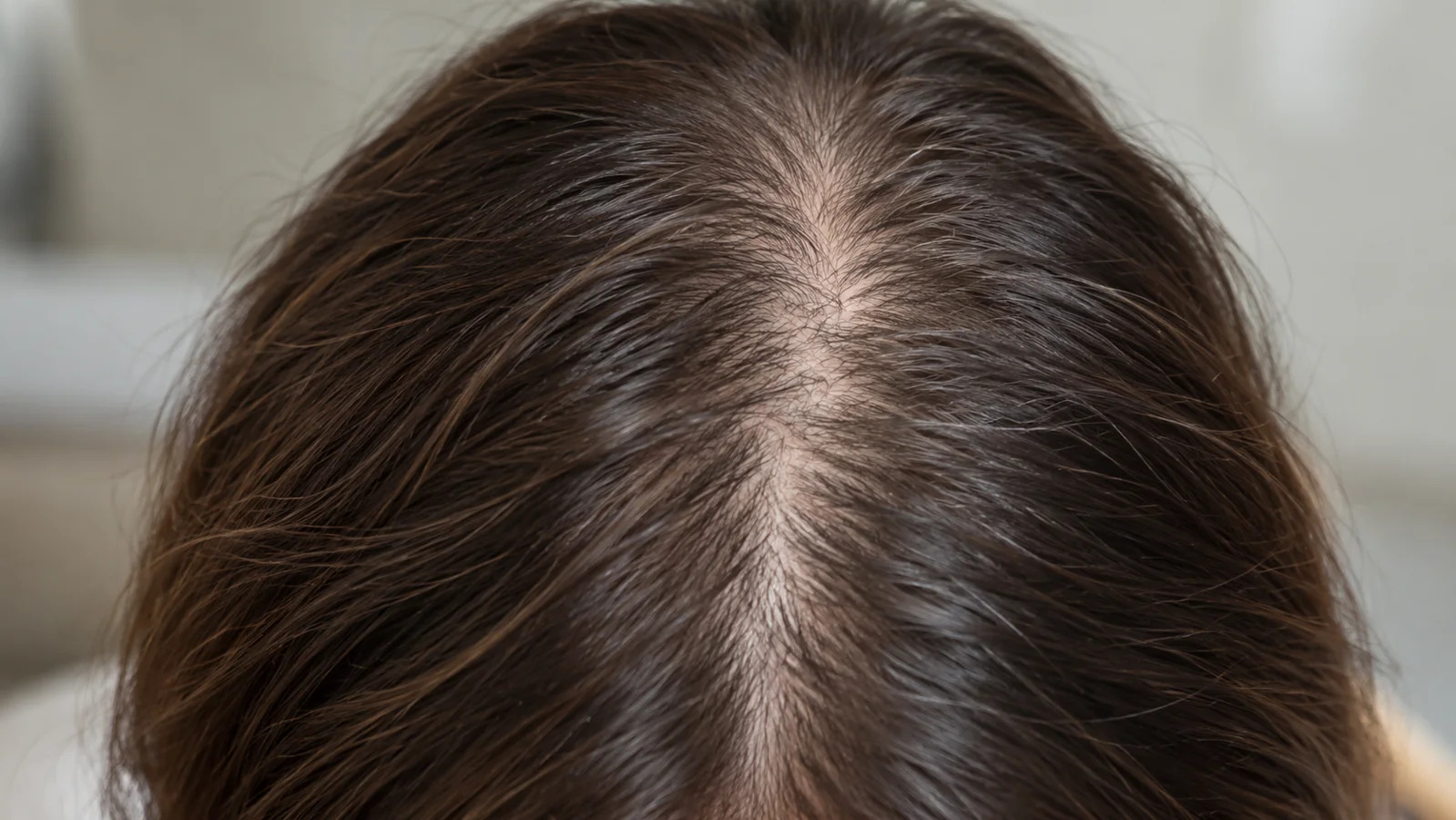
The thinning often discussed with PCOS is called female pattern hair loss. It usually develops gradually. Your middle parting may become wider, or the hair across the top of your head may look less dense. The front hairline often stays much the same.
The British Association of Dermatologists describes this pattern. You can also read our female pattern hair loss guide for a closer explanation.
But what if your hair has suddenly started shedding much more than usual? That deserves a fresh look, even if you already have PCOS. Shedding after an illness can involve telogen effluvium. A round bald patch may have another cause, such as alopecia areata.
More than one cause can be present at once. That is why it helps to describe what has changed rather than assuming every hair problem belongs to your PCOS.
Make your appointment useful

You do not need to wait until your hair loss is severe to ask for help. If thinning is continuing or worrying you, book an appointment with your doctor.
Before you go, think back to when you first noticed it. Was the change gradual, or did shedding increase quite suddenly? Have your periods, acne or facial hair changed too? Older photographs can help show changes that are difficult to describe.
Bring a list of your medicines and supplements. Your doctor can then examine your scalp and decide whether tests would help. Depending on your symptoms, these might include hormone levels, thyroid function or iron levels. Not everyone needs the same tests. The American Academy of Dermatology explains how hair loss is assessed.
One useful question to take with you is: “Does this look like female pattern hair loss, or could something else be contributing?”
If changes happen unusually quickly, seek prompt medical advice. This is especially important if your voice deepens or coarse facial hair increases rapidly. Those changes need assessment rather than being put down to PCOS.
What can treatment actually do?
It is understandable to want your old hair back. Treatment can help some people regain hair, but the result varies. Slowing further thinning can also be a worthwhile benefit, even when regrowth is modest.
Tell your doctor if you are pregnant, breastfeeding or planning a pregnancy. This affects which treatments are suitable.
Minoxidil applied to the scalp
Minoxidil is used for female pattern hair loss. It can help some people keep or regrow hair, but it asks for patience. The American Academy of Dermatology advises allowing about six to twelve months to judge the benefit. If it works, continued use is usually needed to maintain the result.
Some people notice extra shedding at first. Scalp irritation and unwanted facial hair can also occur. Ask your doctor or pharmacist about side effects and how to judge progress, so you know what to expect before starting.
Minoxidil should be avoided during pregnancy, while trying to become pregnant and while breastfeeding.
Medicines that reduce androgen effects
You may have heard of spironolactone. It reduces some of the effects of androgens and is sometimes prescribed for female pattern hair loss. In some countries, this is an off-label use. That means hair loss is not one of the medicine’s officially approved uses there.
The international PCOS guideline says doctors may consider medicines that reduce androgen effects alongside the combined pill for some patients. It also notes that research on their use for scalp hair loss specifically in PCOS is limited.
That makes a discussion about likely benefit especially useful. Ask why the medicine is being suggested for you and when you will review whether it is helping.
Spironolactone can cause dizziness and low blood pressure. It can also raise potassium, a mineral in your blood. Your doctor will decide whether blood tests are needed. The BAD’s patient information explains these risks.
Medicines that reduce androgen effects should not be used during pregnancy. If you could become pregnant, discuss effective contraception with your prescriber.
Will the pill or metformin help your hair?
A medicine prescribed for PCOS may be helping your health even if your scalp hair stays much the same.
The combined contraceptive pill may help irregular periods and some hormone-related symptoms. Scalp hair regrowth is not guaranteed. It is also unsuitable for some people, including some with a history of blood clots or migraine with aura. Aura means warning symptoms such as flashing lights or changes in vision. The NHS explains who may not be able to take the combined pill.
Metformin has a different role. It may be prescribed to help manage blood sugar and other aspects of PCOS. It is not an established treatment on its own for scalp hair regrowth.
If you already take either medicine, ask what it is intended to help in your case. That can make it easier to understand why your doctor might suggest a separate plan for your hair.
What is worth doing at home?
While you work out the cause, keep your routine gentle. Avoid tight styles that pull on thinning areas. Detangle carefully and limit repeated heat damage. These habits can reduce extra damage, although they do not replace treatment for female pattern hair loss.
Food advice can get confusing when every product seems to promise better hormones or thicker hair. Start with regular meals and avoid crash diets. You do not need to buy into an expensive “PCOS diet”. The international guideline does not identify one best diet for everyone, and healthy habits can help even without weight loss.
The same care applies to supplements. Replacing a nutrient you are low in may help address that deficiency. Taking extra vitamins when you do not need them is a different matter. Tell your doctor what you take, because some supplements can affect blood tests. Biotin is one example highlighted by the AAD.
Inositol is often sold for PCOS, but it is not a proven treatment for scalp hair regrowth. A product’s label cannot tell you whether it will help your particular hair loss.
To track progress, take occasional photographs in similar lighting and agree a review date with your doctor. This gives you something clearer to work with than trying to judge small changes in the mirror each day.
Common questions
Can PCOS hair loss grow back?
It can improve, but full regrowth cannot be promised. Treatment may help slow further thinning as well. Ask your doctor what a realistic result would look like for you and how long to allow before reviewing it.
Will treating facial hair help the hair on my head too?
Not necessarily. Hair in these areas responds differently, so improvement in one does not guarantee improvement in the other. Mention both concerns at your appointment so your plan takes each into account.
Is PCOS now called PMOS?
Yes. In May 2026, the condition was renamed polyendocrine metabolic ovarian syndrome, or PMOS. You may see both names during the changeover. They refer to the same condition. The American Society for Reproductive Medicine explains the name change.
Where to go from here
You do not have to work out the cause of your hair loss by yourself. PCOS may be involved, but your scalp still deserves a proper assessment.
Start by asking what type of hair loss you have. Then agree a plan that explains what treatment may help, how long to try it and when to review it. Having those answers makes the next step much easier than choosing another product and hoping for the best.
This article is for general education. A doctor who assesses you can advise on your own symptoms and treatment.